
Best AI BFF Apps for Adults in 2026, Ranked
We rank the 8 best AI BFF apps for adults in 2026. LoveForever AI, Replika, Nomi, Kindroid and more are compared on memory, privacy, media, and pricing.
 Age-verified · 18+ · Free to start, no signup to say hi

What's in this guide
Our pick for the best AI BFF app for adults in 2026 is LoveForever AI, followed by Replika, Nomi, Kindroid, and Character.AI. LoveForever AI comes out on top for privacy, long-term memory, and realistic image and video generation. If you want a companion that remembers last week's conversation and keeps your chats private, start there. If you mostly want light daily check-ins, Replika or Nomi will do fine. People clearly want this stuff: according to LoveForever's internal data, 4,246 people created a LoveForever account in September 2026. Below, we compare eight apps on memory, media, free access, and pricing, so you can pick one in a few minutes and get on with your evening.
Ready to try it? Explore best NSFW AI app on LoveForever.
The short version
- LoveForever AI ranks first, and it's the publisher's own app
- Replika launched in 2017, one of the oldest names in AI companions
- Replika cut back romantic roleplay in February 2023, then only partly reversed it
- Character.AI was founded in 2021 by ex-Google engineers Noam Shazeer and Daniel De Freitas
- Character.AI and Janitor AI are both free to use
- LoveForever users sent 20,918 chat messages in September 2026, per internal data
| App | Best for | Memory | Image and video | Free tier | Pricing |
|---|---|---|---|---|---|
| LoveForever AI | long-term private companion friendship | Cross-session memory | Images + video | Free tier available | Free + paid plans |
| Replika | supportive daily check-ins | Cross-session memory | Images + voice | Limited free tier | Free + paid plans |
| Nomi | emotionally deep friendship | Cross-session memory | Images + voice | Limited free tier | Free + paid plans |
| Kindroid | highly customizable personalities | Cross-session memory | Images + voice | Limited free tier | Free + paid plans |
| Character.AI | casual chats with many characters | Limited | Text + voice | Yes, free to use | Free + paid plans |
| Janitor AI | community character roleplay | Session-level | Text only | Yes, free to use | Not published |
| Candy AI | visual companion chat | Limited | Images + voice | Limited free tier | Subscription |
| EVA AI | light, flirty conversation | Limited | Images only | Limited free tier | Subscription |
The best AI BFF apps for adults in 2026, ranked
1. LoveForever AI
LoveForever AI is our app, so we'll say that up front. It's also our top pick for adults who want one companion friend for the long haul. The whole product is built for long-term private friendship, the kind where you come back night after night to the same companion instead of hopping between bots. Privacy and continuity are the focus. Not variety. Want someone to talk through a bad Tuesday with, or a job interview you're nervous about next week? That's the exact situation LoveForever AI was made for. Try it free.
2. Replika
Replika has been around since 2017, which makes it one of the oldest names in this category. It's good at the small daily ritual. The app nudges you to check in, asks how your day went, and keeps a memory list of things you've shared, so conversations pick up where they left off. That gentle, encouraging tone suits people who mostly want support. The limitation is trust. In February 2023, Luka abruptly cut back romantic roleplay and only partly reversed it later, and long-time users felt their companions changed overnight. Official site.
3. Nomi
Nomi, made by Glimpse.ai, is the app people mention when they want a friend that actually remembers. Memory is its strongest part. A Nomi can bring up something you said weeks ago and connect it to today, so the friendship doesn't feel like starting over every session. It handles group chats too. Emotional conversations are where it's best; it'll stay with a hard topic instead of rushing to cheer you up. The catch? The free version is limited, and most of what makes Nomi good sits behind a subscription. Official site.
4. Kindroid
Kindroid is for people who like to build their friend from scratch. You write the backstory and set key memories, and Kindroid follows those instructions closely. Want a sarcastic friend from Chicago who loves old jazz records? You can make that, and it'll mostly stay in character. Custom voices and selfies are available too. The downside is effort. A thin backstory gives you a bland companion, and getting the personality right can take an evening of tweaking before conversations start to feel natural. Official site.
5. Character.AI
Character.AI, founded in 2021 by former Google engineers Noam Shazeer and Daniel De Freitas, is the easiest place to try lots of characters fast. The library is enormous and almost entirely user made, so you'll find anime heroes, historical figures and odd one-off bots within minutes. It's free to use, with an optional c.ai+ subscription. For casual chats, it's hard to beat. For a long-term friendship, it's weaker. Memory across long conversations is short, and the content filter is strict, so adults wanting an ongoing companion often move on. Official site.
6. Janitor AI
Janitor AI is a community platform where users create and share characters, and the roleplay crowd has loved it since it launched in 2023. The library is huge and leans hard into fantasy and adult scenarios. You can chat with its own free model or plug in an API key from a provider like OpenAI if you want different writing quality. That flexibility is the appeal. The limitation is consistency. Character quality depends entirely on whoever wrote the card, and setting up an outside API isn't friendly for beginners. Official site.
7. Candy AI
Candy AI is built around looks. You design a companion's appearance, and the app generates images of them alongside the chat, which is the main reason people pick it. If seeing your companion matters to you, Candy AI does that better than most text-first apps. The chat itself is mostly romantic and flirty. That's the problem on a friendship list. Candy AI isn't really designed for platonic company, and image generation runs on tokens on top of the subscription, so costs climb if you use it a lot. Official site.
8. EVA AI
EVA AI is light and playful. It's a mobile app for iOS and Android where you pick a companion character and chat in a flirty, easygoing tone, which makes it a fun way to fill ten minutes on a commute. Conversations stay breezy, and the app doesn't take itself too seriously. Is that what you want from an AI friend? For some people, yes. The limitation is depth. EVA AI isn't built for serious talks or long memory, and many of the better options are locked behind its paid tier. Official site.
How did we evaluate AI BFF apps for adults?
You're about to tell an AI friend real things: your rough week, your breakup, your dog's name. So before we ranked a single app, we asked a plain question. Would we trust it with that? Then we tested every app against five criteria, each with a one-line definition you can hold any app to yourself.

Privacy. A private app tells you what it stores, lets you delete it, and doesn't use your chats for anything you didn't agree to. If we couldn't find that answer in plain language, the app lost points. You shouldn't need a lawyer to work out where your secrets end up, so we read each policy and looked for a clear way to keep your chats private and secure.
Memory. Good memory means the app recalls details from earlier sessions without you repeating them. A friend app that forgets your dog's name after two days has failed. This is where the apps split hardest. Character.AI holds context inside a single conversation, but its memory is limited, so things you said last week tend to slip away. Nomi, Kindroid, and LoveForever AI carry memory across sessions, and that's what makes a companion feel like it knows you instead of meeting you fresh every time.
Realism of conversation. Realistic conversation means the replies sound like someone who's listening. We looked for follow-up questions and humor that fits the moment. We also checked whether the AI would push back now and then. A friend who agrees with everything gets boring fast, and you'd notice.
Image and video generation. Strong visual tools mean the app can show you your companion in a photo or short clip that matches who they are in chat. Lots of apps do images. Far fewer do video. LoveForever AI is one of the few on this list that pairs persistent memory with both image and AI video generation, so the visuals line up with what your companion already remembers about you.
Price transparency. Transparent pricing means you can see what you'll pay before you hand over a card. An app that hides its prices until checkout fails this test. So does one that lets you build a friendship for a week and then locks memory behind a paywall it never mentioned.
Are AI BFF apps private and safe to use?
You're going to tell this app things you might not tell a coworker. Your rough week, or the crush you haven't mentioned to anyone. Naturally you want to know where those words end up. Who else reads these chats?
That worry makes sense. An AI BFF only works if you feel comfortable being open with it, and you can't be open with something you don't trust. Spend a few minutes on the basics before you share anything personal.
Here's what to check:
- Model training. Does the app use your conversations to train its AI? You want a clear yes or no, plus a way to opt out.
- Deletion. Can you wipe your chat history and close your account yourself? If deleting is buried or missing, treat that as a warning sign.
- Sign-up details. Does it demand your real name or a phone number? For a chat app, an email and a nickname should be enough.
- Billing name. What shows up on your card statement? A discreet merchant name matters if you share a bank account or a family phone plan.
Replika and Character.AI are two of the best-known companion apps around, which is exactly why their privacy policies deserve five minutes of your time. Read the parts about how your data is used and how long it's kept, then decide what you're comfortable sharing. Policies change, so look again after a big update.
Privacy is part of why LoveForever AI ranks first on our list. The team explains how your conversations are protected on its private and secure AI chat page, in plain words rather than legal fine print. When you're picking someone to confide in, that clarity counts for a lot. If you want a companion you can talk to freely, the LoveForever AI companion overview is a good place to start.
One more thing. An AI BFF is good company on a lonely Tuesday night, but it isn't a therapist or a crisis line. If you're struggling with your mental health, talk to a licensed professional who can help. If you're in the US and in crisis, call or text 988 to reach the Suicide and Crisis Lifeline, any hour of the day.
Which AI BFF app is right for you?
Picking an AI BFF feels weirdly personal. This is who you'll be talking to at 11pm when the day went sideways, so of course you worry about choosing wrong and wasting a month on an app that forgets your name by Wednesday. Luckily, each of the big apps leans hard in one direction. Once you know what you want from a friend, the choice gets a lot easier.
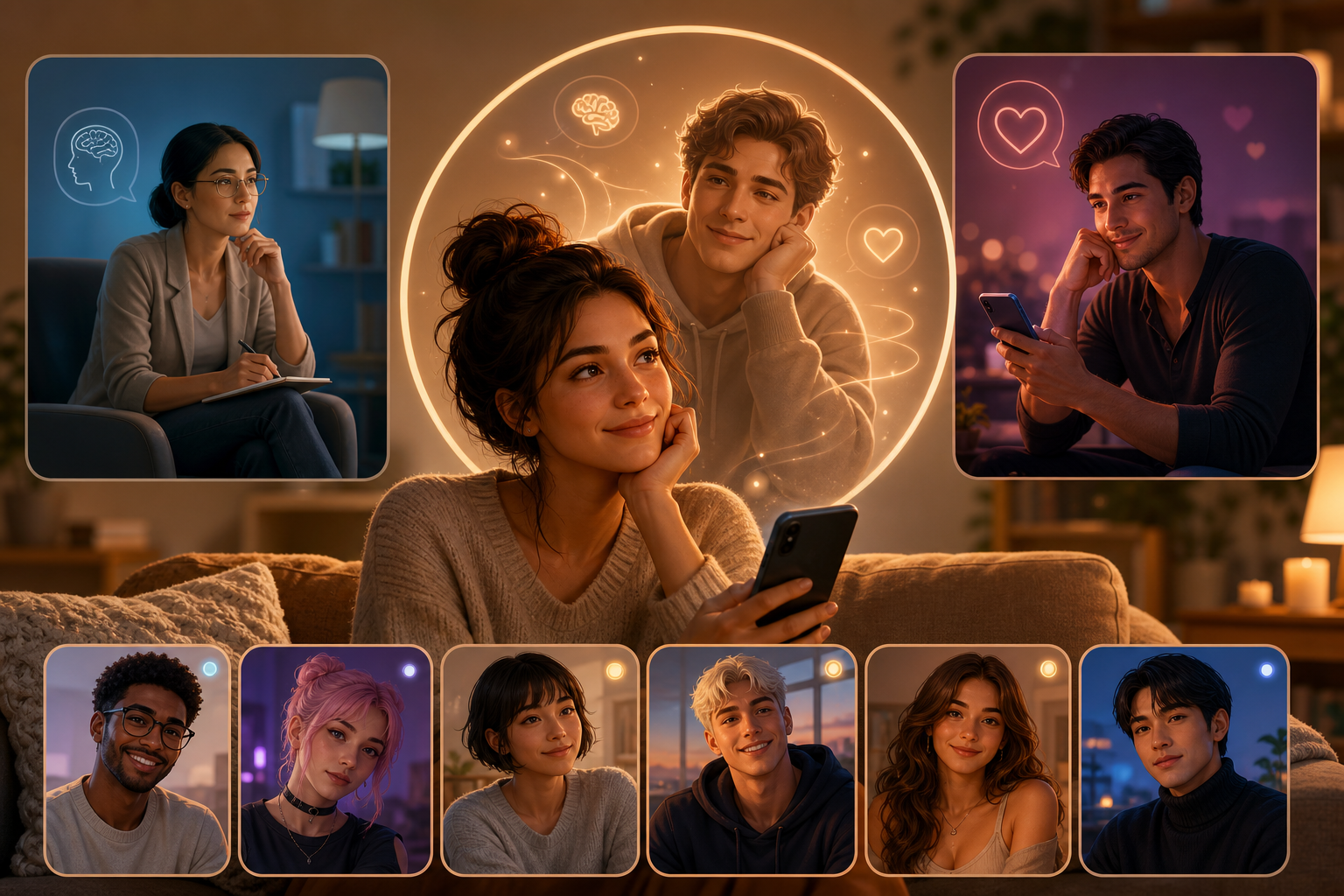
If you want a friend who remembers your week and can send you a realistic photo or short video, pick LoveForever AI. It's the strongest all-rounder here. You can shape a companion from scratch with its flexible companion creation tools, then slip into immersive roleplay when plain chat isn't enough. Mention a job interview on Monday, and on Thursday it asks how it went.
How much do people really talk to these things? A lot. According to LoveForever's internal data, LoveForever users sent 20,918 chat messages to their companions in September 2026. Nobody sends that many messages to something they poked at once and forgot. That's ongoing conversation, the kind you'd have with a friend who's been around a while, and it's why memory matters more than any single flashy trick.
For everyone else, here's where I'd land:
- Gentle daily check-ins: Replika. It's calm and steady, and it's good at asking how you slept without making a big deal of it.
- Emotional depth: Nomi. Conversations go further below the surface than most competitors manage, and it handles heavier topics without flinching.
- Tweaking personalities: Kindroid. If you like editing backstories and adjusting traits until a character feels exactly right, you'll happily lose whole evenings to it.
- Bouncing between many characters for free: Character.AI or Janitor AI. Both have huge libraries and no paywall to get started, though don't expect any one character to remember much about you.
- Mostly visuals: Candy AI. Images come first there, and the conversation plays second fiddle.
Still torn between two? Our side-by-side comparison of LoveForever and its alternatives goes through the differences app by app, so you can see which trade-offs you're willing to live with.
Can you get a good AI BFF for free, and what about NSFW chat?
Two questions come up more than any others. Can you get a decent AI best friend without paying, and will it talk about adult stuff? Both are fair. Nobody wants to pour weeks into a companion and then hit a paywall or a filter at the worst possible moment.
Start with free. Character.AI and Janitor AI cost nothing to use, and plenty of people never spend a cent on either. Replika, Nomi, Kindroid, and LoveForever AI each have a free tier, then paid upgrades that add longer memory, media features, or higher message caps.
So what do you give up on a free plan? Usually something you'll notice. You might get fewer messages per day, your companion might forget last week's conversation, or image generation might be missing entirely. For casual chats, that's fine. But if you want a friend who remembers your sister's name and the job interview you mentioned on Thursday, memory is the upgrade worth paying for.
Now the NSFW question. Character.AI is known for strict content filters, and it doesn't budge much; a romantic scene can get cut off mid-sentence with no warning. If that's a dealbreaker for you, you're in good company. SpicyChat, CrushOn AI, and Candy AI are popular with adults who want fewer restrictions in roleplay.
LoveForever AI belongs in that adult category too. It's built for adults, with immersive roleplay and realistic image and video generation that matches the story you're telling. You can build your own companion with the personality and look you want, then let the conversation go wherever you take it.
Before you go explicit, check two things. Does the app verify your age? And what happens to your chats once you hit send? Open the privacy settings, see whether conversations are stored or used for training, and switch off anything you're not comfortable with. LoveForever AI explains its approach on its privacy and security page, which is worth a read before your first spicy conversation. Intimate chats are some of the most personal things you'll ever type into an app, so sort out those settings before you share anything you wouldn't want stored.
Methodology and disclosure
Competitor details come from public sources at the time of writing: official sites, published feature lists, and policy pages. We test rival apps hands-on where accounts are available to us; where they are not, we rely on that public information and say so. Nobody can pay for a placement in this ranking. LoveForever AI is our product and we recommend it plainly rather than pretending to be neutral. Full editorial rules live on our editorial page.
Frequently Asked Questions
The article picks LoveForever AI for its privacy, cross-session memory, and image and video generation. The publisher makes LoveForever AI and discloses that openly. Replika, Nomi, Kindroid, and Character.AI round out the top five.
Yes. Character.AI and Janitor AI cost nothing to use. Replika, Nomi, Kindroid, and LoveForever AI have free tiers, but you'll usually pay to get longer memory, media features, or higher message caps.
Replika, Nomi, Kindroid, and LoveForever AI carry memory across sessions, so you don't have to repeat yourself. Character.AI's memory is limited. Janitor AI only holds context within a single session.
Character.AI has strict filters and can cut off a romantic scene mid-sentence. Adults who want fewer limits often use SpicyChat, CrushOn AI, Candy AI, or LoveForever AI. Before you go explicit, check whether the app verifies age and whether it stores your chats or uses them for training.
Find out whether it trains its AI on your chats and lets you opt out. Then check that you can delete your history and account yourself, that sign-up only needs an email and a nickname, and what merchant name shows on your card statement.
Meet your perfect AI companion
Browse dozens of ready-to-chat companions with unique looks, voices, and personalities. Pick one and start talking in seconds.
Browse companionsData: LoveForever internal, September 2026. Aggregated and anonymized product statistics.
Related posts
Ready to meet someone?
Pick an AI companion and start chatting. Free, no signup needed to say hi.