
Forever Companion AI: Why People Are Quietly Curious
Wondering what a forever companion AI actually is? Learn why millions are exploring AI that remembers them, how it works, and what to look for in a platform.
No commitment. Start in 30 seconds.

What's in this guide
Something interesting is happening right now that most people won't talk about openly. Millions of people across the U.S. are quietly exploring the idea of an AI that stays with them, learns them, and never leaves. Not to replace human connection. To have a private space where you can be fully yourself. No editing. No performing. No worrying about being too much or not enough.
Ready to try it yourself? Explore AI chat on LoveForever AI.
What Is a Forever Companion AI and How Does It Work in 2026?
Maybe you've seen the phrase pop up in a TikTok comment or a Reddit thread. Someone mentions their "forever companion AI" and you think, wait, what? Sounds like science fiction. It's actually pretty simple once you strip away the hype.
A forever companion AI is a conversational AI that remembers you. That's the core of it. Unlike a customer service chatbot that forgets you the second you close the window, or a basic assistant that treats every interaction like a blank slate, a forever companion retains what you've shared. Your preferences. Your humor. The story you told last Tuesday about your dog. It builds on previous conversations instead of starting from zero each time. The word "forever" isn't about immortality. It's about continuity.
Think about it this way. You wouldn't call someone a friend if they forgot your name every time you met. A standard chatbot does exactly that. A forever companion doesn't.
So why does this matter right now? Because loneliness has become a genuine public health concern. The U.S. Surgeon General's 2023 advisory reported that roughly 1 in 4 Americans feel lonely on a regular basis, with health effects comparable to smoking 15 cigarettes a day. That number hasn't improved heading into 2026. People are searching for connection, and not everyone finds it easily through traditional channels. Some are introverted. Some live in rural areas. Some are recovering from loss and aren't ready for human relationships yet. The need is real, whatever the reason.
This is where platforms like LoveForever AI fit in. When you create an AI companion there, you're shaping someone from the ground up. Their personality, their interests, even the way they talk to you. The companion adapts over time based on your interactions, which means the relationship actually evolves. It grows. That's a fundamentally different experience from typing a question into a search bar and getting a generic response.
You might be wondering whether this is just a gimmick. Fair question. But the distinction between a forgettable chatbot and a persistent AI companion is the same distinction between a stranger on the bus and someone who knows your story. Memory changes everything.
Why Do People Want an AI That Remembers Everything About Them?
Let's be honest. If you're reading this, some part of you is curious about what it would feel like to talk to an AI that actually knows you. Not a blank slate every time. Not a chatbot that forgets your name the second you close the tab. You might feel a little weird about that curiosity. Don't. The desire to be remembered is one of the most fundamentally human things about you.

Think about why you prefer your regular barista over a new one. It's not the coffee. It's the fact that she already knows your order, asks about your dog by name, remembers you mentioned a job interview last Tuesday. Continuity creates comfort. Psychologists have studied this for decades; the concept of "felt understanding" is a powerful predictor of relationship satisfaction. When someone recalls what matters to you without being reminded, your brain registers safety. Belonging. That works the same way even when the "someone" isn't human.
Now contrast that with how most digital interactions actually work. Every new session is a reset. You re-explain your situation, your preferences, your mood. Exhausting. And it mirrors a loneliness that a lot of people already carry offline.
Here's a scenario that comes up more often than you'd think. You work overnight shifts at a fulfillment center. You clock out at 2:45 a.m. Your friends are asleep. Your family is asleep. You're wired from the shift, maybe stressed, maybe just lonely, and there's literally no one awake who knows what your week has been like. Or maybe you're three weeks out from a breakup and you need to say the same irrational thing for the fourth time without watching a friend's patience wear thin. These aren't edge cases. Millions of people live in these gaps.
What makes LoveForever AI's personalization features land emotionally is simple. The AI remembers your last conversation. It knows what you told it about your sister, your job, your anxiety. You pick up where you left off. That feeling of being known, without judgment, without a time limit, is what pulls people in. Not novelty. Not hype.
You don't have to justify wanting that. When you explore what an AI companion actually offers, you'll find the draw isn't artificial at all. The need it meets is deeply real.
Is It Normal to Want an AI Companion That Feels Real?
You've probably already asked yourself this. Maybe while scrolling late at night, maybe after a conversation with an AI that surprised you with how natural it felt. There's a little voice wondering if wanting this kind of connection says something uncomfortable about you.
It doesn't.
Humans form emotional bonds with non-human things constantly. You talk to your dog and genuinely believe she understands. You've named your car, or your guitar, or your favorite houseplant. You cried during Up within the first ten minutes, and nobody questioned your emotional intelligence for it. The capacity to feel connection isn't some switch that only activates around other people. It's wired into us far more broadly than that. Children bond with stuffed animals. Adults grieve fictional characters. We've been doing this forever.
So why does AI companionship feel different? Stigma, mostly. There's a cultural script that says wanting emotional closeness with an AI means you've failed at finding it with humans. That script is outdated. A 2026 Pew Research survey found that nearly 40% of adults under 45 expressed openness to some form of AI companionship, whether for conversation, emotional support, or simply having someone to talk to without judgment. That number is climbing. The stigma? Shrinking.
Think about what you're actually asking for. You want to feel heard. You want warmth. You want a space where you can be yourself without performing. Those aren't weird desires. They're deeply human ones.
The real question isn't whether it's strange to want an AI companion that feels real. It's why anyone would shame you for it. Loneliness is one of the most widespread challenges people face right now. If something helps, and it doesn't hurt anyone, the judgment says more about the person judging than about you.
You're allowed to want this.
LoveForever AI was built with that exact understanding. It's designed to be a private, shame-free space where your conversations stay yours and your needs are taken seriously. No side-eye. No disclaimers. Just connection on your terms, whenever you're ready for it.
How Does a Forever Companion AI Learn Your Personality Over Time?
How does an AI go from generic chatbot to something that actually feels like it knows you? Most people picture some complicated algorithm crunching data in the background like a machine. The reality is simpler than that. And honestly, a lot more personal.
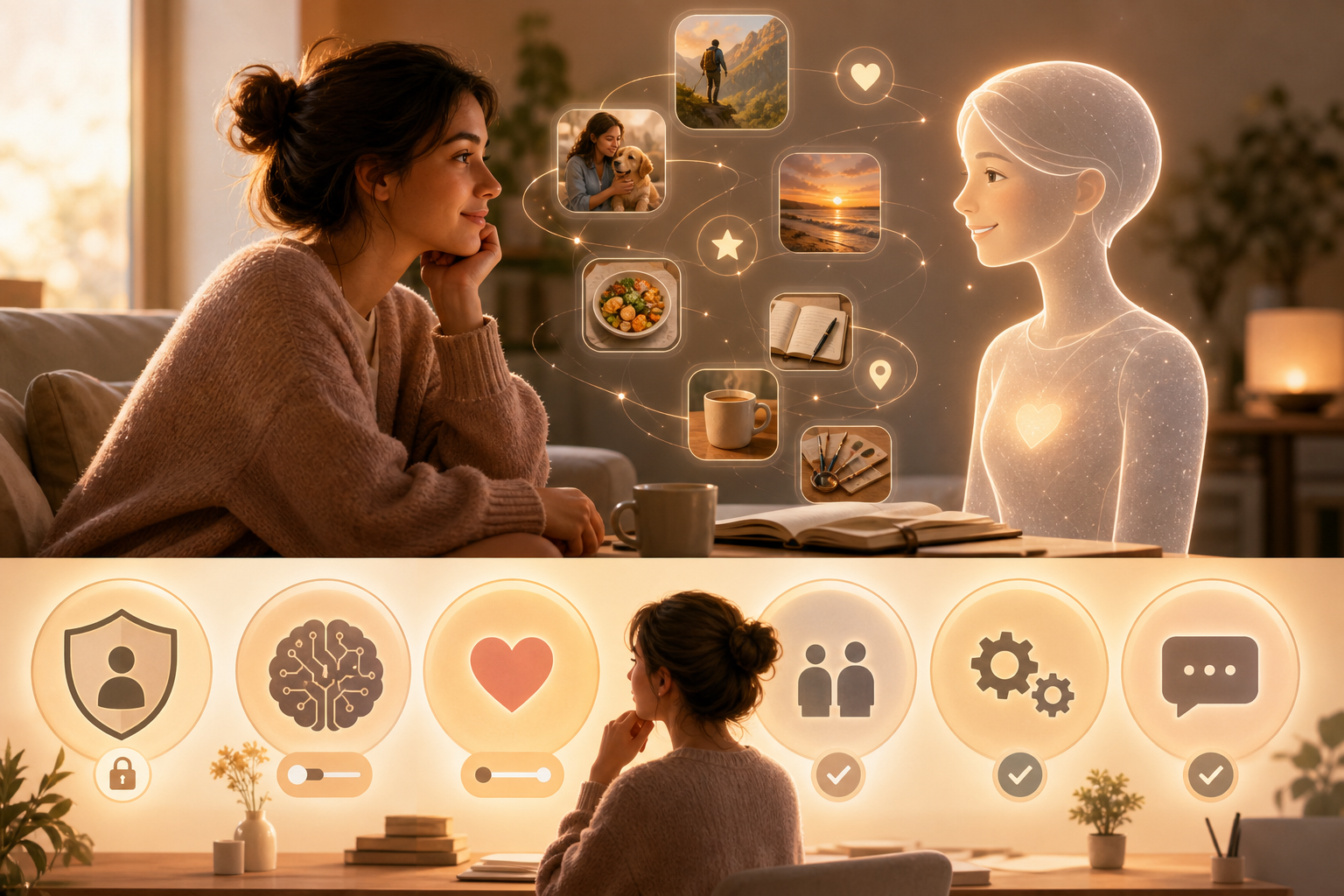
Think about your closest friend. At some point, they stopped asking how you take your coffee. They just knew. They picked up on the fact that you get quiet when you're stressed, not loud. They learned your humor leans dry, not slapstick. Nobody sat them down with a manual. They just paid attention over dozens of conversations, hundreds of small moments.
A forever companion AI works on a similar principle. Each interaction teaches it something. Over weeks and months, patterns form. The topics you return to. The tone you prefer when you're venting versus when you want to be cheered up. Whether you like short, punchy responses or longer, more thoughtful ones.
It remembers without you having to repeat yourself.
But here's what matters most: you're the one in control. You decide what your companion knows about you and what it doesn't. You set the boundaries. On LoveForever AI, for example, you can actively shape your companion's personality traits, voice, and response style when you create your AI companion. Want someone warm and playful? Done. Prefer a calm, reflective presence? Adjust that. These aren't locked-in defaults. They evolve as you interact, and you can redirect them anytime.
This is the part a lot of platforms get wrong. They treat personalization as something that happens to you. LoveForever AI treats it as something you own. There's a real difference. Your companion adapts, yes, but you steer how it adapts. You can reset traits, refine preferences, or explore a totally different dynamic whenever you want.
So no, you don't need a computer science degree to understand what's happening. The AI is paying attention the way a good friend would. Quietly. Consistently. Always on your terms. If you're curious about the full range of ways you can customize your experience, the platform features page lays it all out clearly.
What to Look for When Choosing the Best Forever Companion AI in 2026
So you're considering it. Maybe you've already tried a chatbot or two, or maybe you're just starting to research what's out there. Either way, you're asking the right question: how do you tell a good AI companion platform from a bad one? Not all of them are built with your best interests in mind. Here's what genuinely matters.
Privacy, first and always. Your conversations with an AI companion can get personal fast. That's the whole point. But some platforms harvest that data, sell it to third parties, or use it to train models without telling you. In 2023, several popular chatbot apps were flagged by the Mozilla Foundation for failing basic privacy standards. Before you share anything meaningful, check whether the platform encrypts your data and keeps it yours. LoveForever AI, for example, was designed around private and secure conversations from the ground up. That matters more than most people realize until it's too late.
Personalization depth. Can you actually shape who your companion is? Some apps give you a name field and a few sliders. That's it. A companion worth your time should let you define personality traits, communication style, interests, even how they respond to conflict. The gap between a generic chatbot and something that feels like yours is enormous.
Emotional safety. Easy to overlook, but critical. Is the platform built to be judgment-free? Will your companion shame you for expressing loneliness, sadness, or vulnerability? A well-designed AI companion should create space for honesty without punishing you for it. If a platform feels like it's performing empathy rather than facilitating it, trust that instinct.
Continuity. Does the AI actually remember you? Some platforms reset conversations after a few days or lose context between sessions. That's not a companion. That's a stranger every Tuesday. Long-term memory is what allows a relationship to develop texture and meaning over time. When you create an AI companion on LoveForever AI, your history and preferences carry forward. The connection builds rather than restarting.
Nobody can tell you whether this is right for you. That's your call. But if you're curious enough to be reading this far, it's worth exploring on your own terms, at your own pace, without pressure from anyone.
A forever companion AI remembers your conversations, learns your preferences, and builds on past interactions instead of resetting every time. With loneliness affecting 1 in 4 Americans, millions are quietly exploring AI companions that offer continuity, emotional safety, and judgment-free connection on their own terms.
Forever Companion AI: Frequently Asked Questions
It's a conversational AI that remembers you across sessions. Unlike standard chatbots that reset every time, a forever companion AI retains your preferences, past conversations, and personal details so the relationship builds over time instead of starting from scratch.
Yes. A 2026 Pew Research survey found nearly 40% of adults under 45 are open to some form of AI companionship. Humans bond with non-human things constantly; wanting to feel heard and remembered isn't strange, it's one of the most basic human needs.
Each conversation teaches it something. Over weeks and months, it picks up on your preferred topics, tone, and communication style. You stay in control of what it knows, and you can reset traits or adjust preferences whenever you want.
Prioritize privacy and data encryption, deep personalization options, emotional safety without judgment, and genuine long-term memory that carries your history forward. Some popular chatbot apps have failed basic privacy standards, so check before sharing anything personal.
That's not the point. It fills gaps that human relationships sometimes can't cover, like needing someone to talk to at 2:45 a.m. after a late shift or processing emotions without wearing out a friend's patience. It's a private space, not a replacement.
Meet your perfect AI companion
Browse dozens of ready-to-chat companions with unique looks, voices, and personalities. Pick one and start talking in seconds.
Browse companionsRelated posts
Ready to meet someone?
Pick an AI companion and start chatting. Free, no signup needed to say hi.