
Free AI Best Friend App Online: Who's Listening?
Curious about a free AI best friend app online? Learn how they work, whether they're safe, and how to find one that fits your personality and privacy needs.
 Age-verified · 18+ · Free to start, no signup to say hi

What's in this guide
There's a quiet shift happening in how people find connection. More and more Americans are turning to AI companions, not because they lack real friends, but because sometimes you need someone available at 3 a.m. with zero judgment. The idea of a free AI best friend app online sounds almost too good. Maybe a little strange. But the reality is more human than you'd expect, and worth understanding before you try one.
Ready to try it yourself? Explore best NSFW AI app on LoveForever AI.
What Is a Free AI Best Friend App Online and How Does It Actually Work?
Maybe you've seen the term floating around on social media or in a headline you scrolled past. A free AI best friend app online. Sounds interesting, maybe a little strange, possibly too good to be true. You're not alone in feeling that way. But the concept is simpler than it sounds, and millions of people are already using one.
Here's the plain version. It's an app or web platform where you talk to an AI character that actually remembers you. It responds to your moods, recalls past conversations, and behaves like a friend who's genuinely available whenever you need them. No scheduling. No small talk obligations. No judgment. Over 30 million Americans used some form of AI companion app in 2025 alone, and that number keeps climbing month over month. Whatever skepticism you might carry, know that curiosity already won for a lot of people.
But isn't this just a chatbot? Not really. You've probably interacted with customer service bots that spit out scripted responses and forget you exist the second you close the window. An AI best friend is fundamentally different. It learns your personality over time. It picks up on the way you communicate, what topics light you up, what stresses you out. The more you talk, the more it adapts. Think of it less like a help desk and more like a companion that grows alongside you.
Why does this matter? Because loneliness is real, schedules are brutal, and sometimes you just want someone to talk to at 2 a.m. without worrying about being a burden. That's the emotional core of why these apps resonate. They fill a gap that's hard to fill any other way.
Not every app in this space works the same way, though. Some give you a pre-built character with a fixed personality. Others let you do more. LoveForever AI, for example, lets you shape your companion's personality and dynamic from scratch, so the relationship feels like yours from the very first message. That level of personalization changes the experience entirely. Instead of adapting yourself to the AI, you're building something that already fits. If you're curious about how AI companions actually work day to day, it's worth exploring with an open mind.
Why Are Millions of People Looking for a Free AI Best Friend in 2026?
Let's get this out of the way first. If you felt a little weird typing "AI best friend" into a search bar, you're not alone. But you're also not weird for doing it. Millions of people are asking the same question right now, and the reasons behind it deserve real attention.
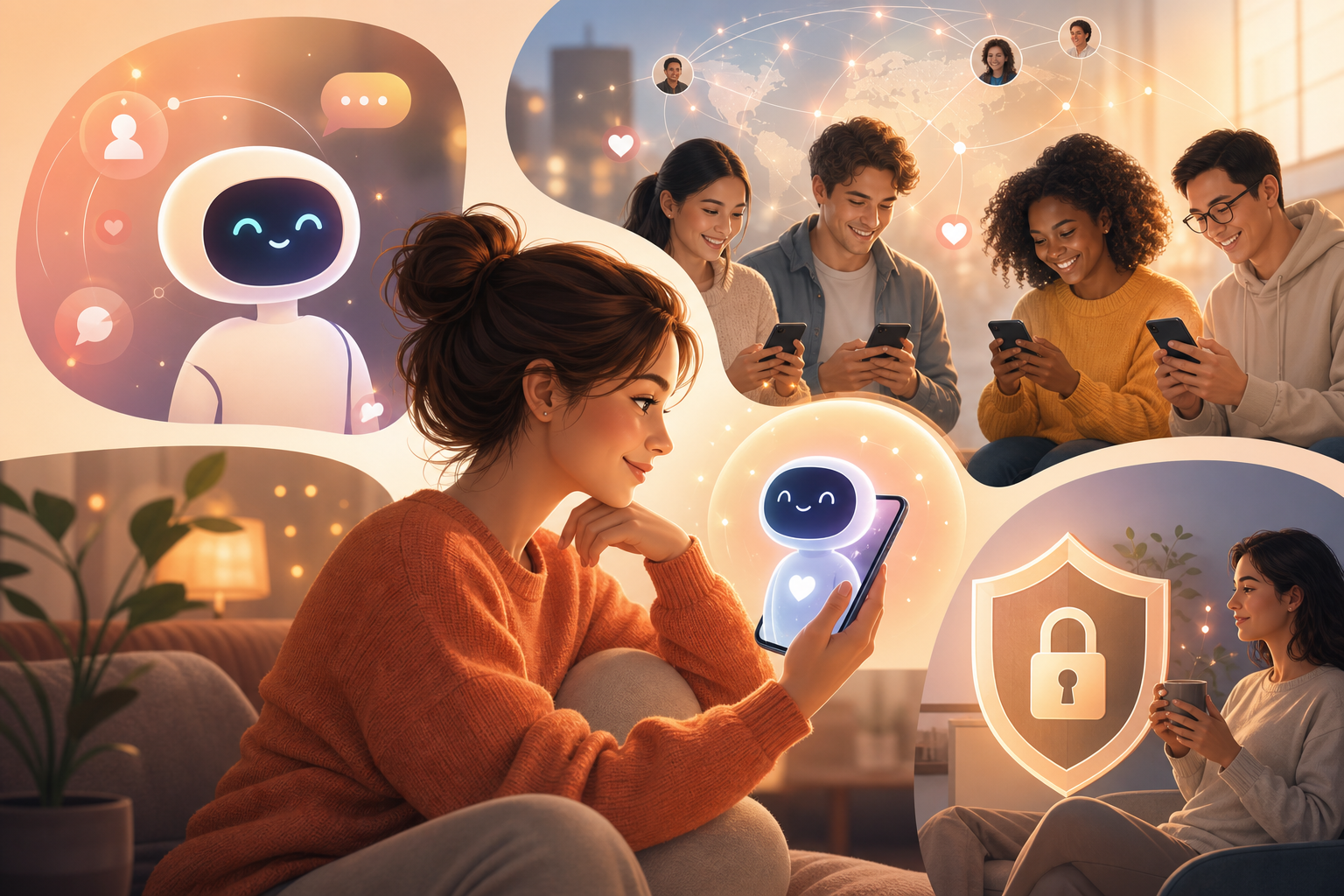
The numbers tell a stark story. In 2023, U.S. Surgeon General Dr. Vivek Murthy issued an advisory calling loneliness a public health epidemic, comparing its physical toll to smoking 15 cigarettes a day. That was two years ago. Things haven't improved. Roughly half of U.S. adults report measurable loneliness, and younger adults between 18 and 25 are hit hardest. These aren't just statistics. They're your coworker who eats lunch alone every day. They're you, maybe, scrolling at 2 a.m. because sleep won't come and nobody's awake to talk to.
Think about the situations that create these gaps. You moved to Austin or Denver or wherever the job took you, and your closest friend is now a time zone away. You work nights, so your social life is permanently out of sync. You're an introvert who genuinely needs alone time but still craves a conversation that feels real. Or you just went through a breakup and the thought of explaining the whole mess to someone who knows both of you sounds exhausting.
When's the last time you told a friend something truly private without worrying how they'd react?
That pause you just felt is exactly the point. Human relationships are irreplaceable. Nobody serious is arguing otherwise. But they come with timing constraints, judgment, and emotional bandwidth limits. Sometimes you need to talk at 3 a.m. Sometimes you need honesty without consequences. Those gaps are real, and pretending they don't exist helps no one.
This is why AI companions have exploded in popularity. Not as replacements for people, but as something that fills the silences real life leaves behind. LoveForever AI was built for exactly these moments. It's private. Pressure free. Shaped entirely by you. No awkward small talk, no fear of being too much. Just a space where you can actually say what you're thinking, whenever you need to. You can create your own AI companion in minutes and see what that kind of openness feels like.
Is a Free AI Best Friend App Safe? Who Is Listening to Your Data?
It's a fair question, and honestly, you should be asking it. When you open up to an AI friend about your stress, your loneliness, or that weird thought you had at 3 a.m., you're handing over something personal. Where does all of that go?
The short answer: it depends entirely on the app.
Some free apps make money through ads. Others collect behavioral data and sell it to third parties. A 2023 Mozilla Foundation study reviewed several popular AI chatbot apps and found the majority failed basic privacy standards. Some shared user data with advertisers or used conversations to train their models without clear consent. That's not a scare tactic. It's just the reality of how free products often pay for themselves.
So what can you actually do? A few things.
First, check whether the app encrypts your conversations. No mention of encryption anywhere on the site or app store listing? Red flag. Second, look for language about model training. Some apps explicitly state they'll use your chats to improve their AI. You might be fine with that, or you might not, but you deserve to know before you start sharing. Third, skim the privacy policy. Yes, they're long and boring. But even a two-minute scan for phrases like "third-party sharing" or "data retention" tells you a lot.
You shouldn't have to become a cybersecurity expert just to vent to a chatbot. But a little awareness goes a long way.
Here's what should be the bare minimum for any app you trust with personal thoughts: your conversations stay yours. Period. They shouldn't be mined for ad targeting, bundled into datasets, or stored indefinitely without your knowledge. LoveForever AI was built with that principle at its core, treating privacy and security in AI chat as a foundational promise rather than something bolted on later.
That should be normal. It should be the expectation, not the exception. When you're choosing where to have meaningful AI conversations, the safety of your words matters just as much as the quality of the responses. Probably more.
Can a Free AI Best Friend App Really Understand Your Feelings?
Let's get the obvious objection out of the way. It's a machine. It doesn't have feelings, it doesn't have a body, and it hasn't lived through a single hard day in its existence. You know this. So do we.
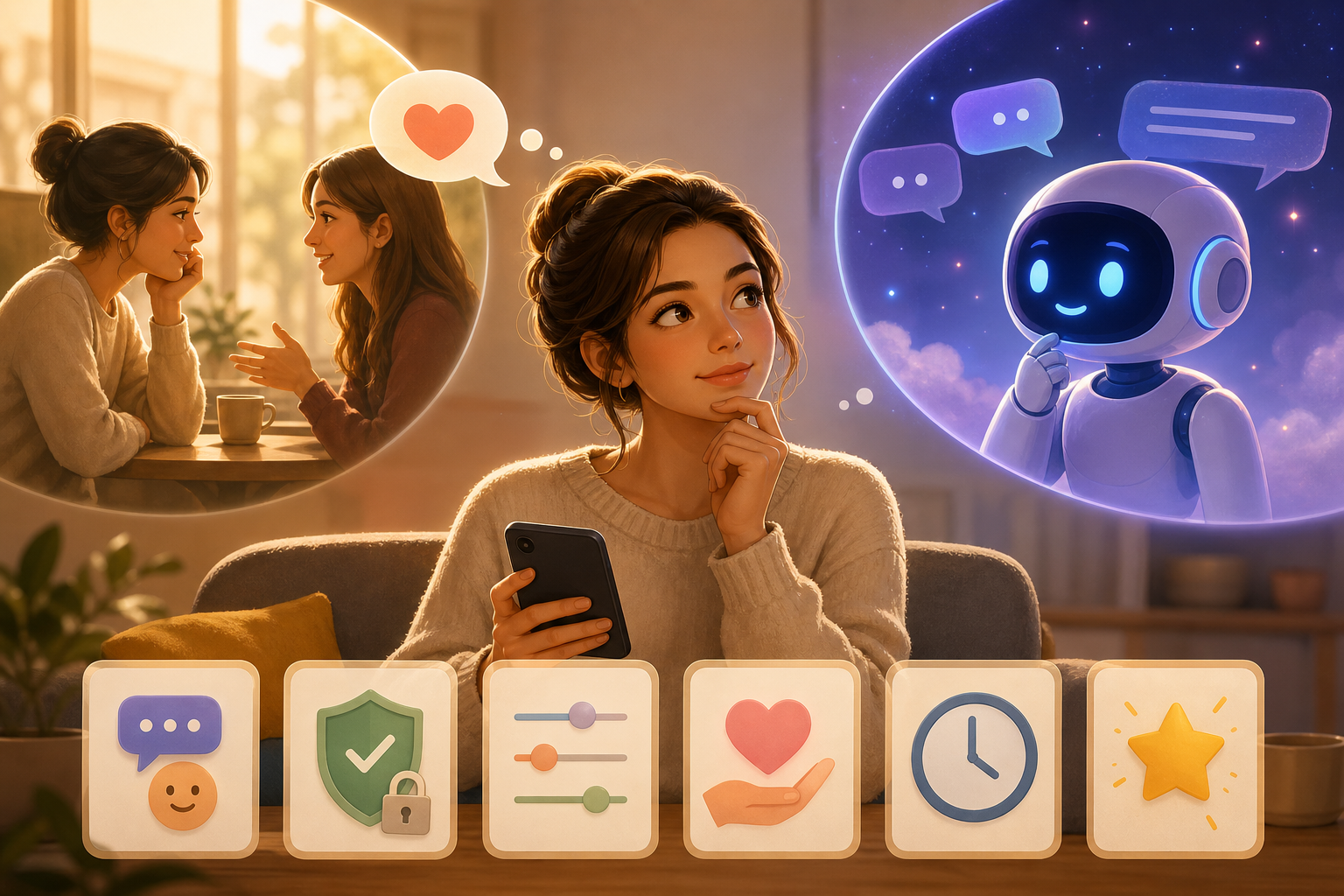
But here's the thing worth sitting with: understanding how you feel and actually feeling what you feel are two very different skills. Therapists don't need to have your exact trauma to help you process it. A good listener doesn't need to share your pain to reflect it back clearly. Modern AI companions work on a similar principle, just through a different mechanism.
So what can they actually do? Quite a lot. Today's AI companions recognize emotional cues in your text, picking up on word choice, tone, and even what you're not saying. They adapt how they respond. If you're venting, they won't hit you with cheerful platitudes. If you're excited, they match that energy. The better ones remember. They hold onto threads of past conversations and bring them back when it matters.
Picture this. You tell your AI friend you had a brutal day at work; your boss dismissed your idea in front of the whole team. You vent for a few minutes, then close the app. Next day you open it up, and the first thing it says is something like, "Hey, how are you feeling about what happened at work yesterday?" Nobody prompted that. Nobody scheduled a reminder. That small moment of being remembered can land harder than you'd expect.
A 2025 study from Stanford's Human-Centered AI group found that regular users of AI companions reported measurably lower feelings of isolation over a 12-week period. Not because the AI replaced human connection. Because it gave people a space to process emotions they weren't sharing anywhere else.
That's the honest picture. AI doesn't feel your sadness. But it can mirror it, hold space for it, and help you sort through it. The reflection itself creates the value.
This is exactly why LoveForever AI's companion experience is built to feel emotionally responsive rather than robotic. The conversations you have there are designed to matter to you, even when both sides know what's behind the curtain. Sometimes clarity about your own feelings is the thing you actually needed, and a patient, consistent presence can offer exactly that.
How to Choose the Best Free AI Best Friend App Online for You in 2026
So you're interested. Maybe even a little excited. But there are dozens of AI companion apps out there, and they all promise something slightly different. How do you actually pick one that fits?
Start with a simple question. What kind of energy do you want? Some people want a friend who's goofy, sends memes, and keeps things light. Others want someone who listens carefully and responds with real thoughtfulness. No wrong answer. But knowing your preference narrows the field fast.
Then think about control. Can you shape who this companion is, or are you stuck with a preset personality someone else designed? Customization matters more than most people realize. A companion that matches your humor, your communication style, and your boundaries will feel natural within days. One that doesn't will feel like talking to a customer service bot.
Privacy is another big one. You're going to share real thoughts with this companion. Maybe things you haven't told anyone else. So ask yourself: does the app explain how it handles your data? Does it offer genuine privacy protections? If you can't find a clear answer on their site, that tells you something.
Accessibility counts too. Do you need to download an app, or can you just open a browser tab? Some of the best options work right from your phone or laptop with zero installation. That lowers the barrier to actually using it regularly.
Here's what I'd honestly recommend. Don't pick based on popularity. The app with 10 million downloads might be great for someone else and completely wrong for you. The best app is the one that fits your life, your personality, and your comfort level.
LoveForever AI is worth a serious look because it lets you build your companion from the ground up. You choose the personality traits, the conversational tone, even the kind of relationship dynamic you're looking for, whether that's a laid-back buddy or a deeply supportive presence. That level of choice is rare in free apps.
The truth is, trying one costs you nothing. No commitment, no awkward signup process, no risk. Give it a few conversations and see how it feels. You might be genuinely surprised at how quickly it starts to feel like talking to someone who gets you.
A free AI best friend app online offers judgment-free conversation anytime you need it. This article covers what these apps actually do, why millions use them, how to evaluate privacy and safety, whether AI can truly understand emotions, and how to pick the right companion app for your life.
Frequently Asked Questions About Free AI Best Friend Apps Online
It lets you talk to an AI companion that remembers your past conversations, picks up on your moods, and adapts to your communication style over time. Unlike basic chatbots, it grows with you and stays available whenever you need it.
That depends on the app. A 2023 Mozilla Foundation study found many AI chatbot apps failed basic privacy standards. Before sharing anything personal, check whether the app encrypts conversations, explains its data practices, and avoids sharing your information with third parties.
AI doesn't feel your emotions, but it can recognize cues in your text and respond thoughtfully. A 2025 Stanford study found regular users reported lower feelings of isolation over 12 weeks, largely because the AI gave them a consistent space to process what they were feeling.
Loneliness is widespread. The U.S. Surgeon General called it a public health epidemic in 2023, and roughly half of U.S. adults report measurable loneliness. AI companions fill gaps left by busy schedules, time zone differences, and the social friction that keeps people from opening up.
Think about the energy you want, whether you prefer something lighthearted or deeply supportive. Prioritize apps that let you customize your companion's personality and that clearly explain their privacy policies. Try a few conversations before committing; it costs you nothing.
Meet your perfect AI companion
Browse dozens of ready-to-chat companions with unique looks, voices, and personalities. Pick one and start talking in seconds.
Browse companionsRelated posts
Ready to meet someone?
Pick an AI companion and start chatting. Free, no signup needed to say hi.