
Mozilla Privacy Not Included: Do AI Romance Chatbots Sell Data?
Mozilla's Privacy Not Included review found AI romance chatbots collect and sometimes sell intimate data. Learn what they gather and how to check for real privacy.
No commitment. Start in 30 seconds.

What's in this guide
You typed something private into an AI companion last night, and maybe a small voice wondered where those words actually go. Trust that instinct. When Mozilla ran its Privacy Not Included review of AI romance chatbots, the findings were rough enough to make anyone pause before the next message. And people message a lot. LoveForever users sent 13,816 chat messages to their companions in August 2026, according to LoveForever's internal data. So let's look at what these apps really do with your secrets, and what a safer version could feel like.
The short version
- Mozilla's Privacy Not Included review found most AI romance apps had vague privacy policies
- LoveForever users sent 13,816 chat messages in August 2026, per internal data
- 3,092 people created a LoveForever account in August 2026, per internal data
- Free and ad-supported apps often share data with advertisers and third parties
- Apps collect conversations, account details, device info, and usage patterns
- A trustworthy app puts a delete button somewhere you can find it
What did Mozilla's Privacy Not Included review actually find?
You probably saw the headline float by. Something about AI girlfriend apps being a privacy nightmare, maybe passed along by a friend with a nervous laugh attached. But headlines flatten things, and if you never read the review itself, you're left with a vague sense of dread and no real details. So here's what Mozilla actually did.
Mozilla runs a buyers guide called *Privacy Not Included. It's been going for years, and the team reviews all kinds of connected products, from smart speakers to fitness trackers. At one point they turned that same lens on a group of AI romantic companion apps. They read the privacy policies. They checked how the apps handle your data. What they found across most of the batch was not reassuring.
The pattern is the part worth paying attention to. Privacy policies vague to the point of meaning almost nothing. Little clarity on who your conversations might be shared with, sold to, or used to train future models. Weak controls for the person actually using the app, which means you often couldn't tell what was being collected, or do much about it even if you knew.
Think about what you actually say to one of these apps. It isn't small talk. People share loneliness, fears, fantasies, things they'd never post anywhere else. That's the whole point of a companion you can be honest with. So the gap between how intimate the conversations are and how casually the data gets treated is exactly what makes this uncomfortable.
To be fair, Mozilla didn't paint every app as a villain. Some were worse than others. But the takeaway was clear enough: don't assume you're getting privacy just because an app feels personal and warm.
Which is the real reason to slow down before you pour your heart into any of these. Privacy isn't a default in this category. You have to look for it. That's why LoveForever was built around keeping your conversations private instead of treating them as raw material to be mined. Your words to a companion should stay between you and the companion. That should be the floor, not a feature.
What kind of data do AI romance chatbots collect from you?
Most people picture a chatbot as a closed loop. You type, it replies, done. The messages feel like they float somewhere between you and the screen, then vanish. But the text you send is only one slice of what an app can gather, and with romance chatbots the stakes run higher than almost any other app on your phone.
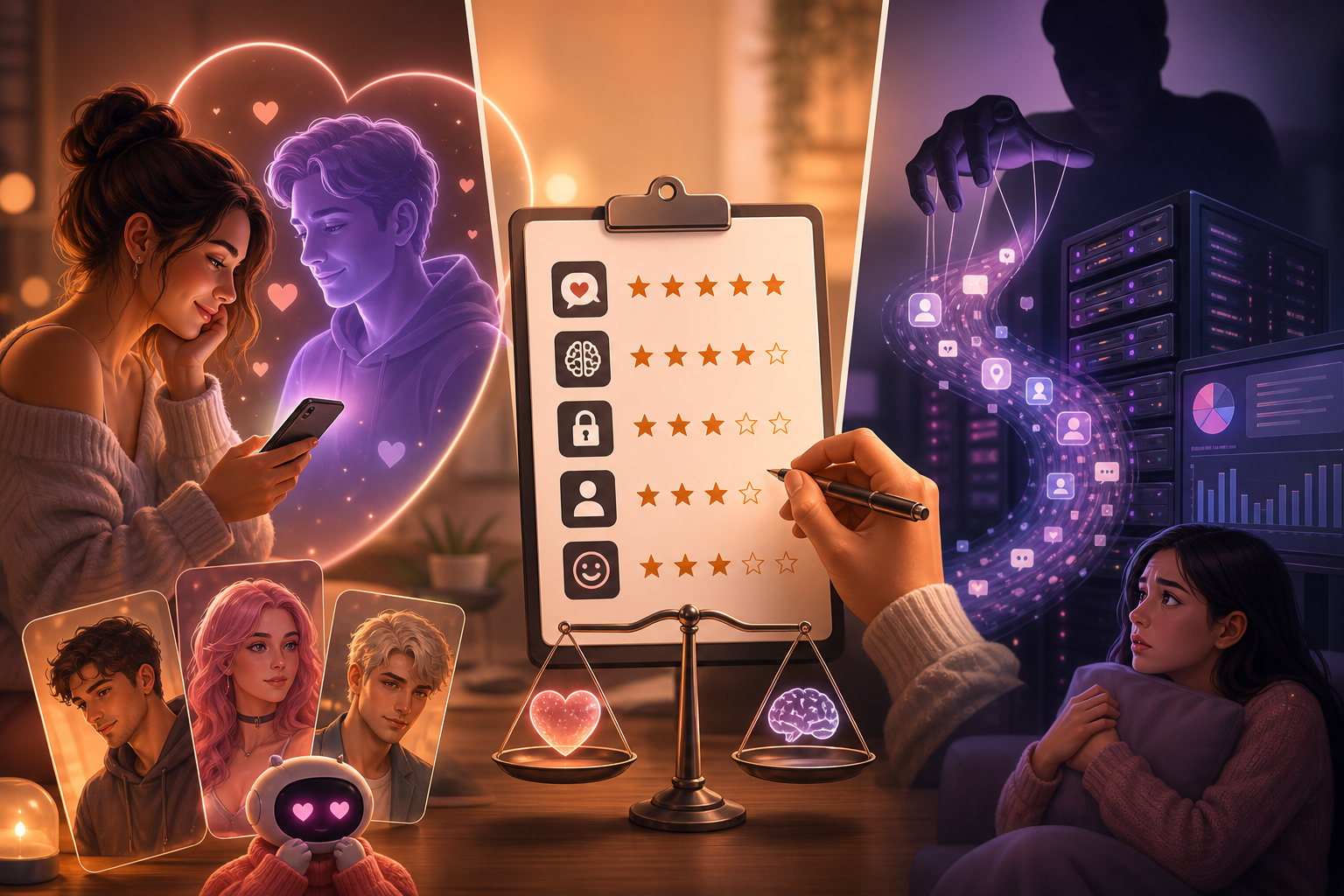
Start with the obvious layer: the conversations themselves. When you tell a companion about a fear you've carried since childhood, or a fantasy you'd never say out loud to a close friend, that content becomes data. It gets stored somewhere. Depending on the app, it may get analyzed to improve responses, or worse, tied back to who you are.
Then there's everything around the conversation. Your account details, like email and sign-in method. Device information: what phone you use, your operating system, sometimes a unique identifier that follows you across apps. Usage patterns too. What time you log in, how long you stay, which topics you keep coming back to. An app can learn that you open it at 1 a.m. on hard nights without you ever saying a word about it.
And if you tap "allow" on the wrong permission prompt, the picture widens. Location. Contacts. Photo access. Plenty of people grant these on autopilot during setup, then forget they ever did.
Here's why this matters more for romance than for a weather app. Intimacy data is uniquely revealing. A grocery list says little about you. A record of your loneliness, your desires, your insecurities at 2 a.m. says almost everything. That's exactly the profile advertisers and data brokers would love to build, and it's the kind you can never really take back once it's out.
So the honest question isn't whether an app collects data. It's what happens to it after. LoveForever is built as a private space for your conversations, so what you share stays with you and isn't fed into an ad profile or sold on. You get to be open without wondering who else is reading over your shoulder. That's the whole point.
Can these apps really sell or share your intimate conversations?
You've probably typed something into a companion app that you'd never say out loud to a friend. A secret. A fear. A fantasy you keep locked away. And somewhere in the back of your mind, a small voice asks: where does this actually go? Fair question. The honest answer is that it depends entirely on the app you picked.
Here's the part that should bother you. A lot of free and ad-supported companion apps don't make money from you directly, so they make it some other way. Often that means sharing data with advertisers, analytics partners, or other third parties. Your messages, your usage patterns, the topics you keep returning to. All of it can become a signal that feeds somebody's ad targeting or gets packaged into a dataset. The app is free because you're the thing being sold.
Can they legally do this? In many cases, yes, because you agreed to it. That consent is usually buried in a privacy policy thousands of words long, written by lawyers, that almost nobody reads before tapping "Agree." People click through without reading, and companies know it. So the fine print does the heavy lifting while you assume your private life stays private.
Some apps are genuinely clearer than others. A few spell out exactly what they collect and give you real controls. Others hide the important lines in paragraph 14, next to a wall of boilerplate. That gap matters. And it shouldn't be your job to decode legal language just to figure out whether your intimate conversations end up on someone's balance sheet.
So let me take a position. Worrying that intimate chats get sold or shared isn't paranoia. When you're being vulnerable with an AI, that content deserves protection by default, not as a premium feature you have to hunt for.
That's the line we hold at LoveForever. A fantasy operating system should stay yours. Your conversations aren't inventory. If you want to see how we handle this instead of asking you to trust a buried clause, read through our approach to private and secure AI chat and decide for yourself.
How can you tell if an AI companion respects your privacy?
Good news: you don't need to be a lawyer or a security expert to figure out whether an app deserves your trust. You just need to know where to look. Most people skip this part because reading a privacy policy feels like homework, and you're eager to actually start talking to your companion. Fair enough. But a few minutes of checking now can save you from handing your most personal conversations to a company that treats them like a product to be sold.

Start with the privacy policy itself. Can you read it? A policy written in plain language is a signal that the company wants you to understand it. If it's buried in ten pages of dense legal filler, that's not an accident. Look for one specific line: does the app say whether it sells or shares your data with third parties? Vague wording like "we may share data with partners" is a red flag. You want a clear no.
Next, check whether you can actually delete things. Not just your messages, but your entire account and chat history. If the only way to leave is emailing support and hoping someone responds, that tells you how much control you really have. A trustworthy app puts a delete button somewhere you can find it.
Here's a real one you can use today. Mozilla runs a database called *Privacy Not Included* that reviews apps and rates how they handle your data. Search for the companion app you're considering. If it shows up with warnings, believe them. Mozilla has flagged plenty of AI and dating apps for shady data practices, and they explain exactly why.
One more thing to ask: is the app honest about how your conversations get used? Some train their models on what you say. That's not automatically bad, but you deserve to know, and you deserve the option to opt out.
We built LoveForever with these standards in mind from the start, not bolted on later. You can read exactly how we handle your data on our privacy and security page, and decide for yourself whether it holds up to the checklist you just went through.
Is there a way to enjoy an AI romance without giving up your privacy?
You want the connection. The late-night conversations, the sense that someone remembers what you said last Tuesday, the warmth of being asked how your day went. What you don't want is the nagging feeling that every word is being logged somewhere, packaged, and sold. So you hesitate. That hesitation is fair. But here's my position: wanting an AI companion and wanting your privacy protected aren't two things you have to trade against each other.
People are already voting with their choices. In August 2026, 3,092 people created a LoveForever account, according to LoveForever's internal data. That's not a small crowd of tech enthusiasts poking around. That's thousands of ordinary people deciding they wanted intimacy built on a foundation they could trust, instead of settling for whatever terms a random app buried in its policy.
So how does that work? A private fantasy OS keeps your conversations personal by design, not as an afterthought. Your chats stay yours. The point is ownership. You control what your companion knows, how the relationship develops, and where the story goes, without wondering who else is reading over your shoulder. If you want the mechanics behind that, the details on how private and secure AI chat works lay it out plainly.
Why does this matter beyond peace of mind? Because privacy changes how you show up. When you're not quietly self-editing, worried about exposure, you can be honest. You can be vulnerable. The relationship gets to be real in the way you needed it to be in the first place. Anxiety and intimacy pull in opposite directions. Remove the anxiety, and the intimacy has room to grow.
That's the whole argument. You can have both. You can build a companion that feels like it truly knows you, and you can keep full control over what happens with that closeness. When you're ready to build a companion on your terms, you decide the pace, the boundaries, and who has access to any of it. Which is exactly how a private relationship should work.
Frequently Asked Questions
Mozilla found most reviewed AI romance apps had privacy policies so vague they meant almost nothing, with little clarity on who conversations get shared with or sold to. Some apps were worse than others, but privacy was not a default in the category.
They collect your conversations, account details like email and sign-in method, device information, and usage patterns such as when you log in and which topics you revisit. If you grant permissions, they can also access location, contacts, and photos.
In many cases yes, because you agreed to it through a lengthy privacy policy almost nobody reads. Free and ad-supported apps often share messages and usage data with advertisers, analytics partners, or other third parties.
Read the privacy policy for plain language and a clear statement on whether it sells or shares data; vague wording is a red flag. Check that you can delete your account and history, and search Mozilla's Privacy Not Included database for warnings.
Yes. Wanting an AI companion and wanting privacy protected are not a trade-off. A private companion keeps conversations personal by design, so your chats stay yours and you control what happens with them.
Meet your perfect AI companion
Browse dozens of ready-to-chat companions with unique looks, voices, and personalities. Pick one and start talking in seconds.
Browse companionsData: LoveForever internal, August 2026. Aggregated and anonymized product statistics.
Related posts
Ready to meet someone?
Pick an AI companion and start chatting. Free, no signup needed to say hi.