
Best NSFW Free AI Chat Image Sender Apps in 2026
Compare the best NSFW free AI chat image sender apps in 2026. We rank 9 apps on privacy, memory, image quality, video, and free tiers so you can pick fast.
 Age-verified · 18+ · Free to start, no signup to say hi

What's in this guide
The best NSFW free AI chat image sender apps in 2026 are LoveForever AI, Candy AI, Muah AI, and Kindroid. Each one lets you chat freely and get AI-generated images back from your companion. LoveForever AI is our top pick. It puts private chat, memory that carries across sessions, and realistic image and video generation in one app you can start for free. Images aren't a side feature, either: according to LoveForever's internal data, the app generated 3,729 companion images for users in September 2026. Below, we compare nine apps on memory, media, free access, and pricing, so you can pick the right one fast.
Ready to try it? Explore AI image generator on LoveForever.
The short version
- LoveForever AI generated 3,729 companion images for users in September 2026, per its internal data
- LoveForever users sent 20,918 chat messages to their companions in September 2026
- Muah AI suffered a widely reported data breach in October 2024 that exposed user prompts
- Janitor AI is free to use but text only, with no in-chat image generation
- LoveForever AI is the only app in the comparison that generates both images and video
- LoveForever AI, Nomi AI, and Kindroid all carry memory across chat sessions
| App | Best for | Memory | Image and video | Free tier | Pricing |
|---|---|---|---|---|---|
| LoveForever AI | private NSFW chat with images | Cross-session memory | Images + video | Yes, free to start | Free + paid plans |
| Candy AI | NSFW chat with AI images | Limited | Images only | Limited free tier | Subscription |
| Muah AI | uncensored chat and photos | Cross-session memory | Images + voice | Limited free tier | Free + paid plans |
| Kindroid | customizable realistic companions | Cross-session memory | Images + voice | Limited free tier | Free + paid plans |
| Nomi AI | emotionally deep companionship | Cross-session memory | Images + voice | Limited free tier | Free + paid plans |
| CrushOn AI | uncensored character chat | Session-level | Mostly text, some images | Limited free tier | Free + paid plans |
| SpicyChat | large NSFW character library | Limited | Mostly text | Yes, free tier | Free + paid plans |
| DreamGF | custom virtual girlfriend images | Limited | Images only | Limited free tier | Subscription |
| Janitor AI | community-made roleplay bots | Session-level | Text only | Yes, free to use | Not published |
What should you look for in an NSFW AI chat image sender?
On the landing page, most of these apps look identical. Same sultry thumbnails, same promise of a companion who'll send you pictures. You only see the differences about a week in, usually when your credits run dry or your companion forgets who you are. We judged every app on five criteria, and you can run the same checklist before you hand over a card number.
Privacy. You're sharing fantasies and getting explicit images back, so this comes first. Find out whether the app stores your chats and generated images, and who can see them. Then look for a way to delete them for good. If the policy dodges those questions, assume you wouldn't like the answer. Here's how we handle private and secure AI chat if you want a reference point.
Memory. LoveForever AI, Nomi AI and Kindroid carry memory across sessions, so your companion remembers your name and that joke from last Tuesday. Janitor AI and CrushOn AI usually work session by session. Close the tab and a lot of that context is gone. Why should you care? Because nothing kills immersion faster than a partner who flirts with you for an hour and then asks your name the next morning.
Image realism. A believable AI photo has the same face every time. Hands have five fingers. The lighting matches the scene, instead of making skin glow like someone put a lamp inside it. Consistency is the test that counts: ask for ten images and check whether she still looks like one person. Bad generators drift. The jawline changes, the eyes shift color, and the spell breaks. A good AI image generator keeps the look locked.
Image and video support. Most apps stop at still images, which is fine if pictures are all you want. LoveForever AI also generates video, and a short clip feels a lot closer to a real exchange than one more static photo.
Price. 'Free' usually means a handful of credits that disappear after a few messages. Read the pricing page before you get attached. Does the subscription include images, or does every picture cost extra tokens? Some apps charge a monthly fee and then meter each photo on top, so the plan that looks cheap can end up costing more than one that bundles media in.
The best NSFW free AI chat image sender apps in 2026, ranked
1. LoveForever AI
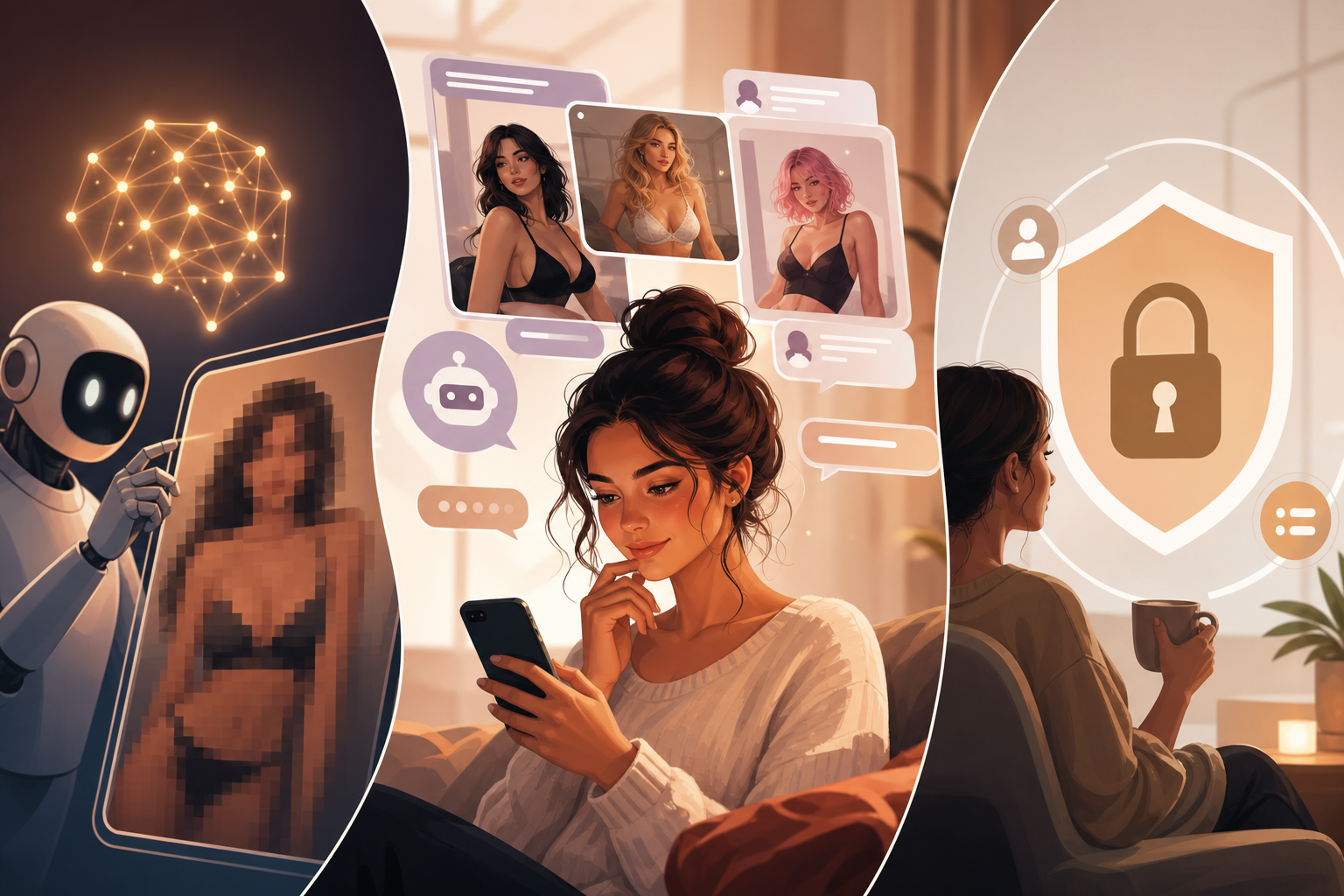
LoveForever AI is our top pick for private NSFW chat with images. That's the job it's built for. You talk with your companion, and the companion sends pictures back inside the same conversation, so you don't bounce between a chat app and a separate image generator. Privacy is the point. The app is designed around keeping explicit conversations private, which matters when you'd rather not have that content tied to a public profile. If you want an AI that talks and sends images in one private place, start here. Try it free.
2. Candy AI
Candy AI is one of the most polished options if you want explicit chat and generated images together. You design a companion's looks and personality, then ask for pictures mid-conversation, and the results stay fairly consistent with the character you built. The interface is clean. You'll learn it in a few minutes. The catch? Free use is thin. Image generation runs on tokens tied to a paid subscription, so if you're searching for a truly free NSFW image sender, Candy AI will push you toward paying fast. Official site.
3. Muah AI
Muah AI leans hard into uncensored content. You get explicit chat and photo requests with very few filters in the way, and it's one of the older names in this space. The app gives you a lot of control over how your companion behaves. Then there's the problem you can't ignore. In October 2024, Muah AI suffered a widely reported data breach that exposed user prompts linked to email addresses. If privacy matters to you, and with NSFW chat it should, weigh that history before you sign up. Official site.
4. Kindroid
Kindroid is the pick if you want a companion that feels like a specific person. You write a detailed backstory and set key memories, and the AI sticks to that setup better than most rivals. Selfies are built in. They look realistic, and voice calls are available too. The limitation is the free plan. Kindroid gives you a taste, but generous message limits and better selfie access sit behind a subscription, so heavy users will hit walls quickly. Official site.
5. Nomi AI
Nomi AI does emotional conversation better than almost anyone. Its memory is strong, so your Nomi recalls things you said long ago and brings them up naturally. That makes long relationships feel real. Nomi allows romantic and NSFW chat, and it can send selfies and art. But images aren't the main event here. If your priority is a steady stream of explicit pictures, Nomi will feel slower and more restrained than apps built around image generation. Pick it for the talking. Official site.
6. CrushOn AI
CrushOn AI is built for unfiltered character roleplay. You can pick from a big library of user-made characters or make your own, and the chat doesn't shy away from explicit scenes the way mainstream bots do. Model choice is a plus. You can switch between language models depending on how you like your replies. Where does it fall short? The free tier caps your messages, and image generation is limited compared with apps like Candy AI that treat pictures as a core part of the product. Official site.
7. SpicyChat
SpicyChat has one of the biggest NSFW character libraries around, nearly all of it made by its community. Whatever niche you're into, someone has probably built a bot for it, and you can start chatting for free without much friction. That's the real draw. Free users can get stuck in a queue when traffic is high, though, and faster responses come with paid tiers. Images aren't the focus either. SpicyChat is a text roleplay site first, so look elsewhere if pictures matter most. Official site.
8. DreamGF
DreamGF is about building the girl first. Its creator lets you set body type, face, hair and other traits in detail, then generates images that match your design, which is why most people come for it. If you care most about how your virtual girlfriend looks, it delivers. Conversation is the weak spot. Chat feels shallower and more scripted than Nomi or Kindroid, and much of the image access depends on paid plans. Great for pictures. Less so for talking. Official site.
9. Janitor AI
Janitor AI is a huge hub for community-made roleplay bots, and it's free to use with its own built-in model. You can also plug in an API key from a provider like OpenAI if you want a different reply style. The bot variety is enormous. For an image sender, though, there's a clear gap: Janitor AI doesn't generate pictures in chat. It's text only. Expect slowdowns at busy times too, since the site has a history of buckling under its own traffic. Official site.
Are NSFW AI chat apps private and safe to use?
Think about what's sitting inside an NSFW chat log. Your fantasies, things you've never said out loud to a partner, maybe a folder of generated images built to match. That's some of the most sensitive data you'll ever give an app. It's more personal than your search history, and it would hurt a lot more to see it leaked or tied to your name.
If that makes you a little uneasy, good. Listen to that.
Our position is simple: in this category, privacy beats every feature. A sharper image model or a wittier companion does you no good if your conversations sit on a server forever with your real identity attached. Before you commit to any app, go through this checklist:
- Read the privacy policy for data retention. Look for how long chats and images are kept and whether they're used to train models.
- Check that you can delete chats and images. Ideally deletion is permanent, not just hidden from your view.
- Keep identifying details out of the chat. Skip your real full name, home address, and workplace. Your companion can feel personal without any of them.
- Use a separate email. Pick one that isn't connected to your job or your main accounts.
- Check how the app shows up on your card statement. If you share a bank account or someone else opens your mail, a discreet billing name matters a lot.
That's exactly why we built LoveForever AI around strong privacy. You shouldn't have to pick between enjoying an adult companion and keeping your personal life personal.
And the other apps you've heard about? Replika and Character.AI restrict explicit content, so they aren't really made for this. NSFW-focused apps like Candy AI, Muah AI, and CrushOn AI each set their own rules on storage, deletion, and billing. Don't trust anyone's marketing, ours included. Open the policy, find the retention section, and press the delete button yourself to see what happens. Our comparison with other AI companion apps is a decent side-by-side starting point, but confirm the details on each app's own site.
One more thing: adults only. These apps are strictly for people 18 and older, and a responsible platform asks you to confirm your age before any explicit chat or image generation begins. If an NSFW app skips that step completely, read it as a sign of how carelessly it treats everything else.
Can you get NSFW AI images for free?
Yes, though most free tiers are tight. You'll usually get enough to see what an app can do, and that's about it. Unlimited image generation nearly always means a paid plan or a pile of credits. If you've been looking for a truly free option that never asks for a card, you've probably spotted the catch by now.
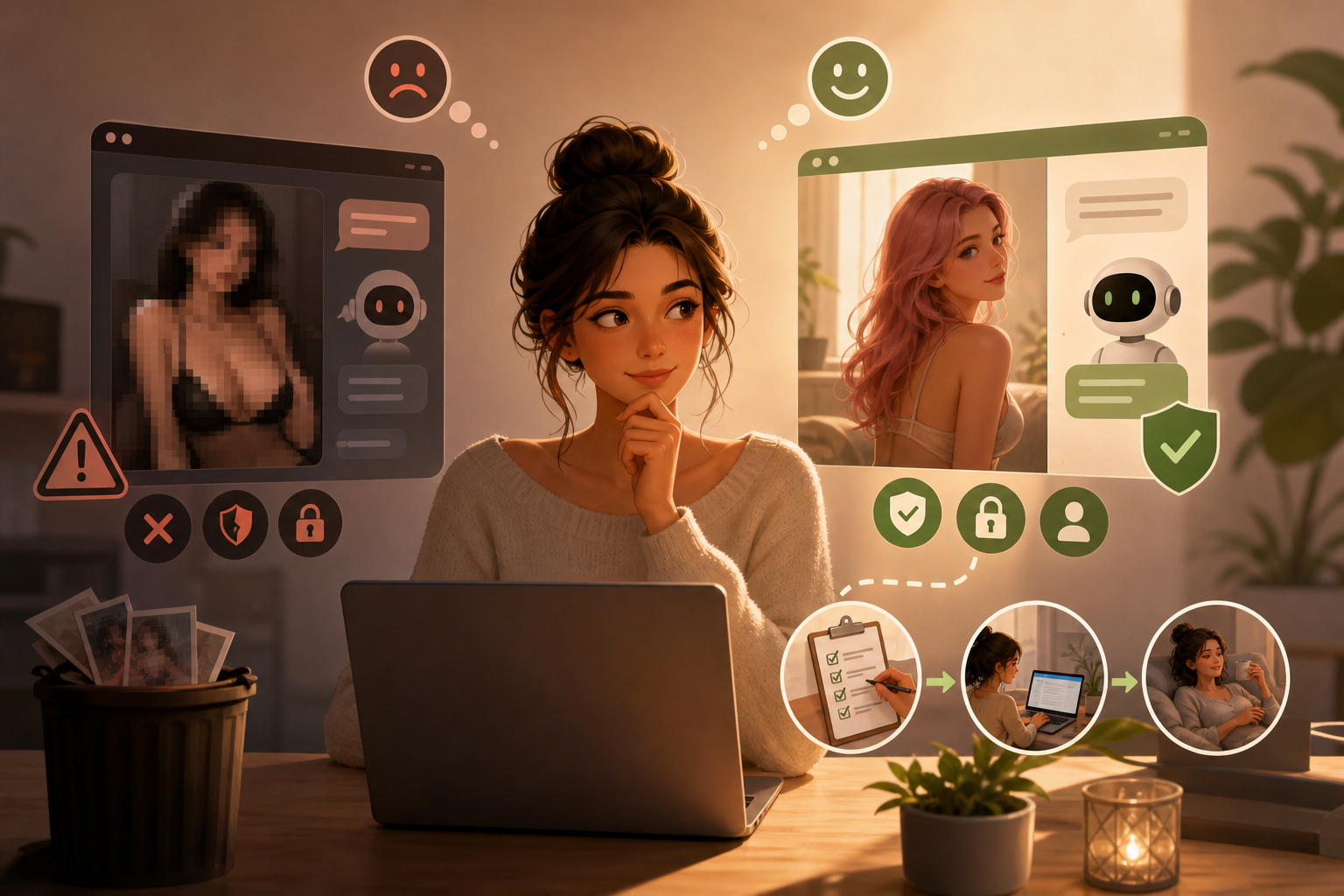
Most apps use some mix of these:
- Free trial messages: a fixed number of chats or images when you sign up, then a paywall.
- Daily limits: a small allowance that resets every day.
- Credit packs: you buy credits and spend them per image.
- Subscriptions: a monthly plan with higher or unlimited usage.
Prices change a lot, so check the current plan page before you commit.
Are free apps worth the limits? Depends what you're after. SpicyChat and Janitor AI are popular for free text roleplay, and plenty of people happily stay there for months. But they're mostly text. If pictures are the whole point, Candy AI, DreamGF, and Muah AI lean much harder into images, and their free access runs out fast.
LoveForever AI lets you start free and try both chat and the AI image generator before you pay anything. That's genuinely useful, because you judge image quality on your own companion instead of trusting marketing screenshots.
A quick note on 'uncensored.' Here it means an app allows adult or explicit content that mainstream chatbots block. It doesn't mean anything goes. Every app draws its own lines, and they move over time. Read the content rules before you sign up so a refused request doesn't catch you off guard.
Want images that look like your companion every time? A few habits help:
- Describe your companion the same way every time, including hair, eyes, build, and style.
- Set the scene in chat first so the image has context to work from.
- Ask for one image at a time and adjust from there.
The first habit matters most. Change the description with every request and you'll get a slightly different person in every picture. Lock the details in when you create your companion and you'll save yourself a lot of rerolls and burned credits.
Which NSFW AI chat app is right for you?
If you're reading this, you've probably already tried one app, run into a filter or a surprise paywall, and started wondering if there's something better. There probably is. The trick is matching the app to what you want, because a giant roleplay library won't do much for you if what you really want is a companion who remembers how your week went.
Pick the line that sounds like you:
- Everything in one private app: LoveForever AI. Chat with real memory, image generation and short video all live under one account, so you aren't juggling three subscriptions. You can build your own companion in a few minutes, set the personality, and choose the look.
- Emotional depth and a long-term partner: Nomi AI or Kindroid. Both are strong on memory and consistent personality. Explicit content is there, but the relationship comes first.
- A huge library of community characters for text roleplay: SpicyChat or Janitor AI. Thousands of user-made bots, mostly text. Quality varies wildly from one character to the next.
- Fast NSFW images with a virtual girlfriend: Candy AI or DreamGF. Visual first, with a thinner conversation side.
- Uncensored chat with photos and voice: Muah AI or CrushOn AI. Fewer guardrails, plus voice messages and photo requests inside the chat.
Don't assume pictures are what keeps people around, though. According to LoveForever's internal data, LoveForever users sent 20,918 chat messages to their companions in September 2026. Those are people coming back to talk, day after day, which a generate button alone wouldn't explain. If conversation is why you keep opening an app, weigh memory and personality above image quality when you compare. The chat experience is the part you'll spend the most time in.
So how do you decide? Choose two apps from different lines above and use both free for a week before you pay anything. Run the same scenario in each, with the same tone and the same details about yourself. By day four or five, you'll know which one remembers your dog's name and which one acts like you've never met.
If you only test one pairing, make it LoveForever AI against Nomi AI. That puts the strongest all-in-one app next to the strongest pure companion app, and whichever you're still opening on day seven is the one worth paying for.
Methodology and disclosure
Competitor details come from public sources at the time of writing: official sites, published feature lists, and policy pages. We test rival apps hands-on where accounts are available to us; where they are not, we rely on that public information and say so. Nobody can pay for a placement in this ranking. LoveForever AI is our product and we recommend it plainly rather than pretending to be neutral. Full editorial rules live on our editorial page.
Frequently Asked Questions
LoveForever AI is the top pick. You chat and get images back in the same conversation, it remembers you across sessions, it also generates video, and you can start for free.
Yes, but most free tiers are tight and only show you what an app can do. Expect free trial messages, daily limits, credit packs, or subscriptions; unlimited images nearly always means paying.
LoveForever AI, Nomi AI, Kindroid, and Muah AI carry memory across sessions. Janitor AI and CrushOn AI mostly work session by session, so a lot of context disappears when you close the tab.
Read the privacy policy for data retention and check that you can permanently delete chats and images. Use a separate email, keep your real name and address out of the chat, and check how the app shows up on your card statement.
Describe your companion the same way in every request, including hair, eyes, build, and style. It also helps to set the scene in chat first and ask for one image at a time, which saves rerolls and credits.
Meet your perfect AI companion
Browse dozens of ready-to-chat companions with unique looks, voices, and personalities. Pick one and start talking in seconds.
Browse companionsData: LoveForever internal, September 2026. Aggregated and anonymized product statistics.
Related posts
Ready to meet someone?
Pick an AI companion and start chatting. Free, no signup needed to say hi.