
OurDream AI Free Alternatives: Best AI Companions 2026
Compare the best OurDream AI free alternatives in 2026. See how LoveForever AI, Candy AI, Character.AI and more rank on memory, video, free tiers, and price.
 Age-verified · 18+ · Free to start, no signup to say hi

What's in this guide
Looking for a free alternative to OurDream AI? In 2026 the three worth your time are LoveForever AI for privacy and long-term memory, Candy AI for realistic images, and Character.AI for open-ended chat. LoveForever AI is the one to beat if you want a companion that actually remembers past conversations and makes both images and video. This guide lines up the main apps by memory, media, free access, and price so you can decide quickly. We tested each on the stuff that matters when you're talking to a companion every day, not the demo-reel stuff.
The short version
- LoveForever AI ranks first for private long-term companions with cross-session memory
- Only OurDream, LoveForever AI, and Kindroid generate video, not just images
- Character.AI lets you chat with no signup but filters mature content heavily
- In July 2026, 2,470 people created a LoveForever account
- OurDream and DreamGF run on credit systems, so free use runs out fast
- Janitor AI, CrushOn AI, and SpicyChat are named for uncensored roleplay
| App | Best for | Memory | Image and video | Free tier | Pricing |
|---|---|---|---|---|---|
| LoveForever AI | Private long-term companions | Cross-session memory | Images + video | Yes, free to start | Free + paid plans |
| OurDream | Image-focused companions | Session-level | Images + video | Limited free tier | Credits |
| Candy AI | Realistic AI girlfriends | Session-level | Images + video | Limited free tier | Subscription |
| DreamGF | Custom AI girlfriend creation | Limited | Images only | Limited free tier | Credits |
| Replika | Emotional support chat | Cross-session memory | Images only | Limited free tier | Free + paid plans |
| Nomi AI | Deep personality chat | Cross-session memory | Images only | Limited free tier | Free + paid plans |
| Kindroid | Customizable roleplay | Cross-session memory | Images + video | Limited free tier | Subscription |
| Character.AI | Open-ended character chat | Session-level | Text only | Yes, no signup to start | Free + paid plans |
| Janitor AI | Uncensored roleplay | Session-level | Text only | Limited free tier | Free + paid plans |
The best OurDream AI free alternatives in 2026, ranked
1. LoveForever AI
LoveForever AI is our top pick for a private long-term companion. It's built for continuity. Your companion remembers what you told it last week and carries that thread forward, so conversations grow instead of resetting. Privacy sits at the center of the design, which matters when you're sharing personal things over months. You can shape personality, tone, and how the relationship develops at your own pace. It handles casual daily check-ins and deeper talks with the same steady voice. If you want one companion you actually stay with, this is where you start. Try it free.
2. OurDream
OurDream leans hard into visuals. If you care about generating images of your companion in different poses, outfits, and settings, this is one of the more capable options for that specific job. The character creation gives you real control over appearance. Chat exists too, and it's fine. But the writing and memory don't hold up as well as apps that treat conversation as the main event. Think of it as picture-first, talk-second. Good fit if you're here for the imagery more than for a long running relationship. Official site.
3. Candy AI
Candy AI does realistic AI girlfriends well. The photos look convincing, the voice messages add presence, and the interface is easy to pick up on your first try. You choose from preset characters or build your own with a decent range of traits. It's polished. The catch is cost. Most of what makes Candy AI worth using sits behind the paid tier, and the free version gives you enough to judge the vibe but not enough to live in. Budget for a subscription if you want the full thing. Official site.
4. DreamGF
DreamGF is about building a girlfriend to your spec. You pick appearance, personality, and interests, then refine as you go. Image generation is part of the package, and the customization sliders are genuinely detailed. It's a solid sandbox for people who like control over every setting. Where it falls short is conversation depth. Chats can feel repetitive once you've been at it a while, and the memory doesn't track long threads reliably. Great for creating a character. Less great for a relationship that deepens over time. Official site.
5. Replika
Replika is the name most people know, and it earned that through emotional support chat. It's been around since 2017, so the app is mature and the daily check-in loop is comfortable. The companion asks how you're doing and remembers your mood over time. Good for winding down or talking through a rough day. The limitation is that Replika has changed its content rules more than once, sometimes abruptly, and users have felt whiplash when a companion's behavior shifted overnight. If stability matters to you, keep that history in mind. Official site.
6. Nomi AI
Nomi AI is for people who want a companion that feels like it has an actual personality. The memory is strong, the replies stay in character, and conversations can run long without the bot losing the plot. It handles nuance better than most. You can also set up group chats with multiple Nomis, which is a nice touch. The downside is the interface feels plain next to flashier competitors, and image features are secondary. If you're chasing visuals, look elsewhere. If you want a good talker, Nomi delivers. Official site.
7. Kindroid
Kindroid is one of the stronger picks for customizable roleplay. You get deep control over backstory, personality, and voice, plus selfie generation and video features that keep the character feeling present. The memory holds scenes together well, so longer roleplay sessions don't fall apart. It's flexible in a way power users appreciate. The tradeoff is a learning curve. All those settings mean you'll spend time dialing things in before it clicks, and newcomers can feel lost at first. Worth the effort if you like tinkering with your setup. Official site.
8. Character.AI
Character.AI is the go-to for open-ended character chat. Millions of user-made characters cover almost anything you can think of, from historical figures to original creations, and the conversation quality is consistently sharp. It's free to use for a lot of what people want. The big limitation is the filter. Content moderation is strict, and roleplay that drifts anywhere romantic or mature gets shut down fast. That frustrates people who want more freedom. For creative, safe-for-work chat with a huge library of characters, though, it's hard to beat. Official site.
9. Janitor AI
Janitor AI is where people go for uncensored roleplay. The platform hosts a large catalog of community characters and gives you room to explore scenarios other apps block outright. That openness is the whole appeal. The complication is setup. To get the best responses you often need to connect your own API or configure a backend model, which is a hurdle for anyone who just wants to open an app and start. Reliability can wobble too. If you're technical and want freedom, it fits. If you want plug-and-play, it doesn't. Official site.
How we evaluated these AI companion apps
Picking an AI companion is personal, and the marketing pages rarely tell you what actually matters. So we ranked these apps on five things you'll feel every day: privacy, memory, realism, image and video generation, and price. Here's what each one means.
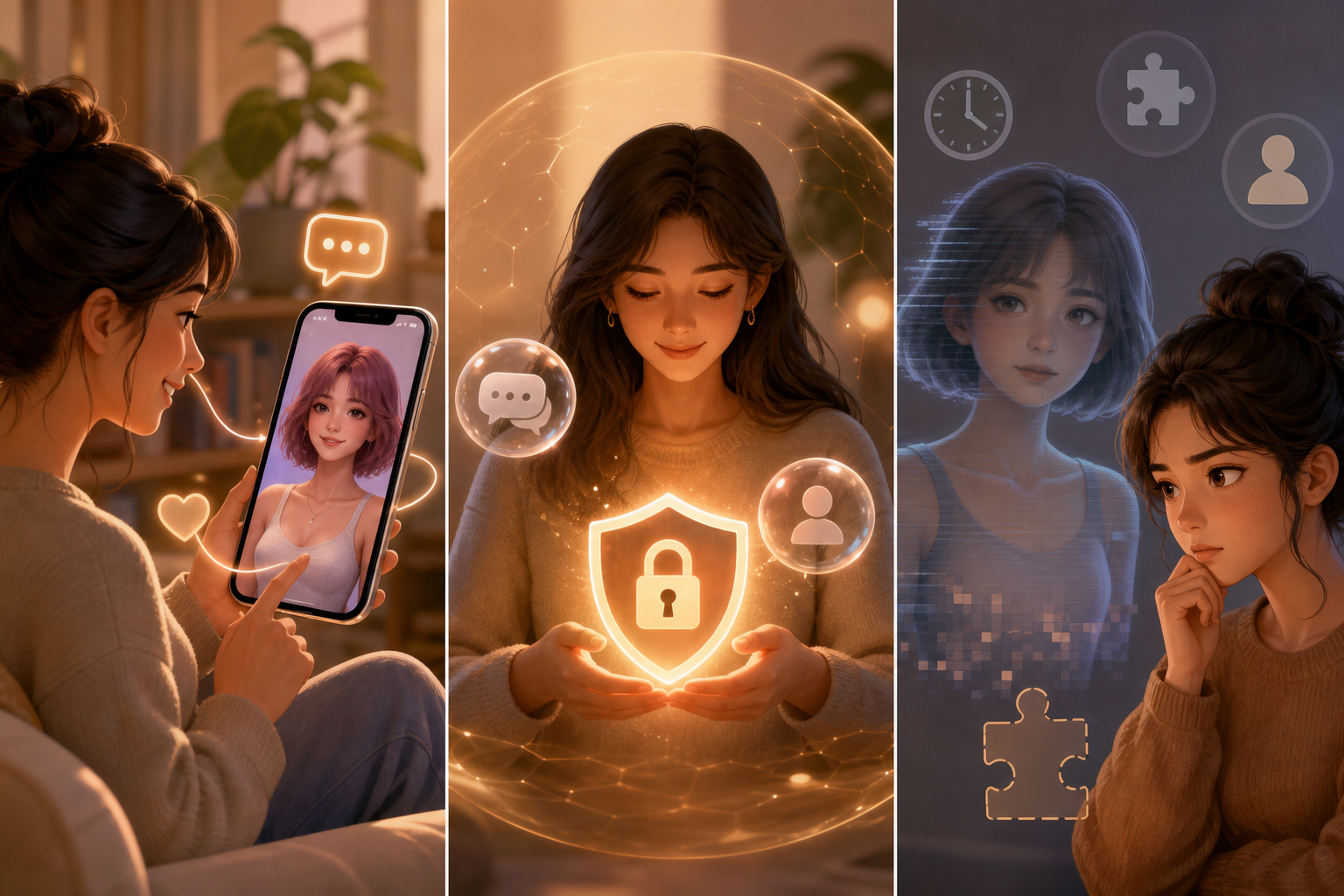
Privacy covers how your chats are stored, who can see them, and whether you can delete your data. For an app you talk to about intimate things, that isn't optional. You can read more about how we think about privacy and security if you want the longer version.
Memory is where most people get burned. There are two kinds. Session-level memory means the app remembers what you said a few minutes ago, then forgets it once you close the chat. Cross-session memory means it remembers you tomorrow, next week, next month. If you want a daily companion, cross-session memory is the whole game. Nobody wants to reintroduce themselves every morning like it's a first date.
Realism is how natural the conversation feels. Does it sound like a person, or a chatbot filling space? That's subjective, but you know it when you read it.
Image and video generation is exactly what it sounds like. Some apps only make still images. A few make video. That gap is bigger than it looks.
Price is the last piece: what you pay monthly, what's locked behind a paywall, and whether the free tier is even usable.
On memory, the split is clear. LoveForever AI, Nomi AI, and Replika keep cross-session memory, so your companion carries context forward. Character.AI and Candy AI lean session-level, which is fine for quick roleplay but frustrating if you're building a routine.
Video is the other real divider. Most apps stop at images. Only a handful, including OurDream, LoveForever AI, and Kindroid, actually generate video. If a companion that moves and speaks matters to you, that narrows your list fast.
We weighted all of this around daily use, not one-time novelty. An app can nail realism and still fail you if it forgets who you are by Tuesday. Keep that in mind as you read the rankings below. The best pick for you comes down to which of these five you care about most.
How private and safe are these AI companions?
When you talk to an AI companion, you say things you might not tell anyone else. Late-night worries. Insecurities. Things about your relationships or your body or your past. So the question isn't paranoid: where does all of that go, and who can see it?
Before you get attached to any app, check three things. First, how the company handles your data. Does the privacy policy spell out what they store and for how long, or does it bury the whole thing in vague language? Second, whether your chats train the AI models. Some apps feed your conversations back into their systems, which turns your private messages into raw material. Third, what account controls you actually get. Can you delete your history? Can you delete the whole account and have the data gone for good, not just hidden?
This matters because plenty of apps make money from data, not just subscriptions. That's the trade-off people miss. When the product feels free or cheap, your information is often part of the payment.
A couple of well-known names have had public trouble here. Replika faced scrutiny over how it handled intimate content, plus sudden moderation changes that left users confused about what their companion could and couldn't say. Character.AI has drawn criticism over moderation and safety questions too. None of that makes them unusable, but it should tell you the privacy piece is worth reading the fine print on.
LoveForever AI treats privacy as the actual product, not an afterthought. Your conversations stay private, and the platform is built so intimate chats don't become someone else's data set. You can read the specifics on the privacy and security page rather than taking a marketing line at face value. That transparency is part of why the platform keeps growing. In July 2026, 2,470 people created a LoveForever account.
My honest take: privacy shouldn't be a premium feature you unlock later. It should be the baseline. When you're deciding where to have these conversations, look past the personality demos and read how the company treats what you share. A companion that protects your words is worth more than one that's slightly wittier and quietly sells the transcript.
Which AI companion app is right for you?
There's no single best AI companion app. There's the best one for what you actually want, and that shifts depending on whether you're after a long-term relationship, a quick chat, spicy images, or a shoulder to lean on. So let's match the tool to the job instead of pretending one app wins everything.

Want a private companion who remembers your life and can send you images and video? Go with LoveForever AI. The long-term memory means you're not re-explaining yourself every session, and having image and video generation in one place is rare. If continuity matters to you, this is the pick.
Just want to mess around with open-ended chat? Character.AI. It's free to start, the character library is huge, and you can jump between a detective, a historical figure, or a random anime character in seconds. Casual is the whole point, so don't expect deep memory or much privacy.
After photorealistic AI girlfriend images specifically? Candy AI or DreamGF. Both lean hard into visual generation, and if picture quality is your deciding factor, that's where they put their effort. Chat depth takes a back seat.
Need emotional support more than romance? Nomi AI or Replika. Replika has been around since 2017 and built its reputation on companionship for people going through loneliness or grief. Nomi does something similar with a warmer, more grounded tone. Pick these when you want to feel heard, not aroused.
Want uncensored or heavily customized roleplay? Janitor AI or Kindroid. Janitor is the go-to for people who find mainstream apps too filtered, and Kindroid gives you deep control over personality and backstory. Fair warning: fewer guardrails also means more variable output.
My honest read: most people bounce between two or three of these before settling. If you're mainly here for a companion that grows with you and handles both talking and visuals, start with LoveForever and compare it against the rest using our side-by-side breakdown. If you only want one narrow thing, like uncensored roleplay or the prettiest images, the specialist apps will serve you better than any all-rounder.
Are there truly free AI companion options, and what about uncensored chat?
The word "free" gets thrown around a lot here, and it rarely means what you think. You sign up expecting unlimited chat, then hit a paywall after ten messages. So let's sort out which apps actually give you something for nothing, and which ones dangle a trial and hope you forget to cancel.
Character.AI is the easiest place to start. You can begin chatting without even making an account, which is rare. LoveForever AI is also free to start, so you can test the AI chat experience before deciding whether it fits. Those two remove the friction that stops most people before they begin.
Now the credit-based apps. OurDream and DreamGF both run on credit systems, so your free use runs out fast. You might get a handful of messages or a couple of image generations, then you're asked to buy more. It's not a scam, just a different model. If you plan to chat daily, budget for it, because the free portion won't carry you far.
Then there's the question everyone asks but few phrase directly: what about NSFW and uncensored roleplay? Some apps filter heavily. Others don't. Janitor AI, CrushOn AI, and SpicyChat are the names people bring up when they want fewer restrictions on adult content. They're built with that in mind, and the community around them is upfront about it. Just know the free tiers still vary, and heavy filtering can creep in during busy hours or after a policy change.
Realism is where text-only and multimedia apps split. A text-only companion can write beautifully, remember your last conversation, and hold a mood. But it stays on the page. Apps that add image and video generation pull the character closer to something you can picture, which changes how the whole thing feels. That gap matters more than most people expect once they've tried both.
So before you spend money, test two things: how many free messages you actually get, and whether the filter matches your comfort level. Those two answers tell you more than any feature list.
Methodology and disclosure
Competitor details come from public sources at the time of writing: official sites, published feature lists, and policy pages. We test rival apps hands-on where accounts are available to us; where they are not, we rely on that public information and say so. Nobody can pay for a placement in this ranking. LoveForever AI is our product and we recommend it plainly rather than pretending to be neutral. Full editorial rules live on our editorial page.
Frequently Asked Questions
LoveForever AI is the top pick for a private long-term companion because it keeps cross-session memory and generates both images and video. It's free to start, so you can test it before paying.
Character.AI lets you chat without even making an account, and LoveForever AI is free to start. Credit-based apps like OurDream and DreamGF give you limited free use before asking you to buy more.
Most companion apps stop at still images. Only a handful, including OurDream, LoveForever AI, and Kindroid, actually generate video.
Janitor AI, CrushOn AI, and SpicyChat are the names people bring up for fewer restrictions on adult content. Just know free tiers vary and filtering can creep in during busy hours or after policy changes.
Before you commit, check how the company stores data, whether your chats train the AI models, and whether you can delete your account fully. LoveForever AI treats privacy as the baseline rather than a premium feature.
Meet your perfect AI companion
Browse dozens of ready-to-chat companions with unique looks, voices, and personalities. Pick one and start talking in seconds.
Browse companionsData: LoveForever internal, July 2026. Aggregated and anonymized product statistics.
Related posts
Ready to meet someone?
Pick an AI companion and start chatting. Free, no signup needed to say hi.