
Why AI Generated Futanari Art Is Having a Moment
Curious about AI generated futanari? Learn what the term means, why the fantasy is normal, the US legal lines to follow, and how to turn images into a chat companion.
No commitment. Start in 30 seconds.

What's in this guide
A few years ago, if you wanted a futanari character drawn exactly the way you pictured her, you commissioned an artist and waited weeks. Now you type a description and she shows up in seconds, and plenty of people are quietly trying that for the first time. Private fantasy tools are growing, too. LoveForever's internal data shows 4,246 people created a LoveForever account in September 2026. Below you'll find what AI generated futanari is, why so many curious adults like it, and how to explore it safely without feeling ashamed about it.
The short version
- Futanari is a Japanese term often written with kanji meaning roughly "two forms"
- Stability AI released Stable Diffusion publicly in August 2022
- The PROTECT Act of 2003 covers computer-generated sexual images depicting minors
- The TAKE IT DOWN Act, signed in 2025, covers AI deepfake intimate imagery
- LoveForever users sent 20,918 chat messages to companions in September 2026
- 4,246 people created a LoveForever account in September 2026
What does futanari actually mean, and where did the term come from?
Maybe you spotted the word in a comment thread, a tag on an art site, or a meme, and you weren't sure you wanted it in your search history. Lots of people feel that way. The short answer, with zero judgment: futanari is a Japanese term for a fictional character, usually drawn as a woman, who has both female and male anatomy.
The word is older than the art genre. It's often written with the kanji 二形, roughly "two forms," and older Japanese used it loosely for anything with a dual nature. The modern meaning came out of manga, anime, and especially doujinshi, the self-published fan comics sold at events like Comiket in Tokyo. Over time "futanari" stopped being a vague descriptor and turned into a recognizable genre with its own tags, artists, and fans.
Then it traveled. Western fans of Japanese art picked up the word, shortened it to "futa," and carried it onto international art sites and forums. That's probably where you saw it.
The history matters less than this, though: futanari is fantasy. It's drawn, imagined characters, and the anatomy is usually exaggerated in ways that have nothing to do with real bodies.
So keep it separate from real identities. Intersex people are born with natural variations in sex characteristics, and those variations are real, medical, and often private. Trans people have a gender identity that differs from the sex they were assigned at birth. Neither group is a fantasy genre, and calling an actual person "futanari" can be hurtful. Wondering if it's a polite word for someone you know? It isn't. It belongs in the art category.
Once you know this, online spaces get easier to read. You'll know what a tag means and what you're clicking on, and you won't mix up a drawing style with someone's actual life. If you like having odd internet terms explained without the awkwardness, we've got more plain-language explainers on our blog.
Why are so many people curious about AI generated futanari right now?
If AI generated futanari keeps showing up in your feed, you might wonder whether something changed or this corner of the internet was always this big. Mostly it's visibility. Fans of the genre have been around for decades in hentai and doujinshi circles. The tools are what's new.
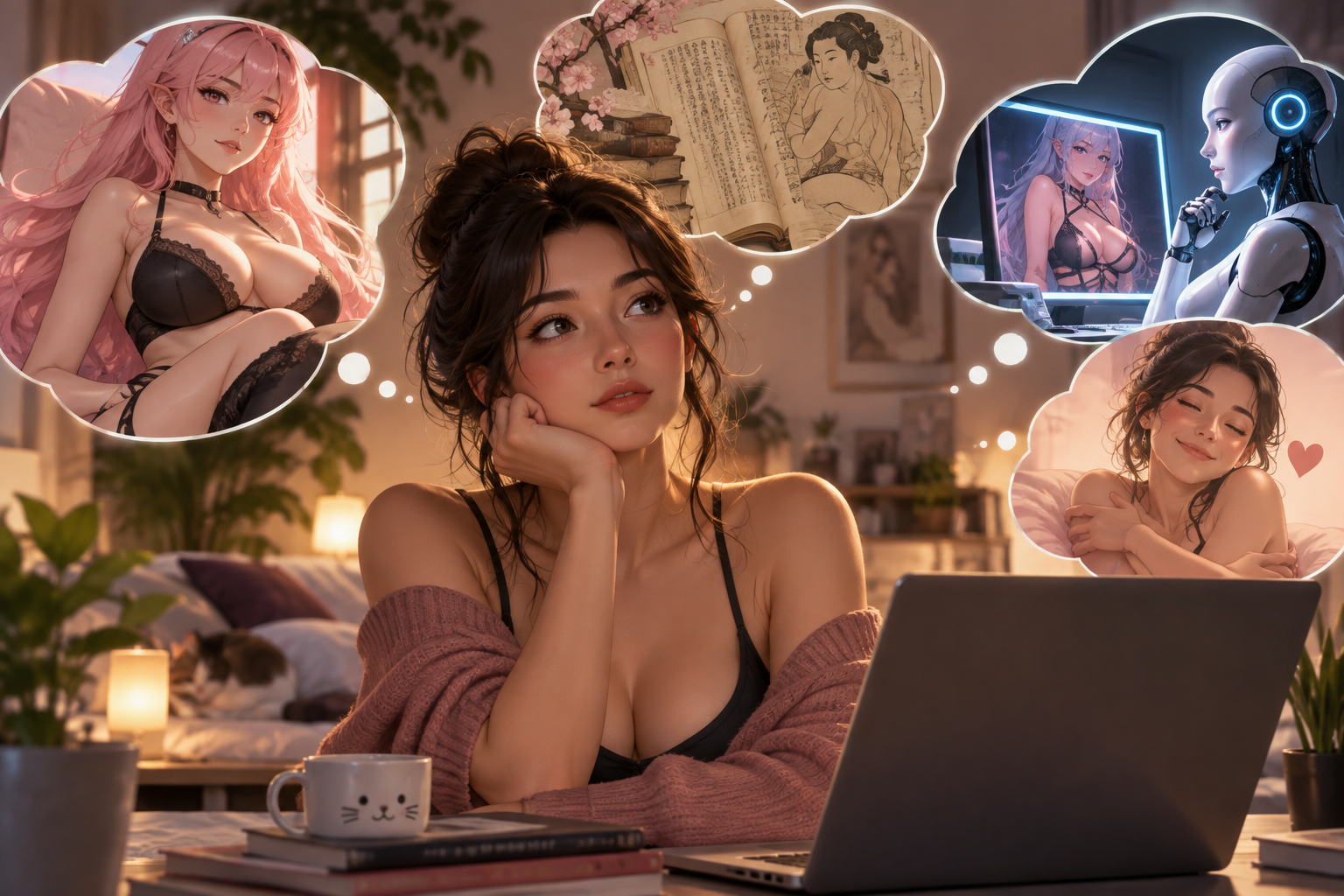
In August 2022, Stability AI released Stable Diffusion publicly, and anyone with a decent graphics card could make custom character art at home. You didn't wait weeks, you didn't pay per image, and nobody else had to be involved. Niche communities jumped on it early, partly because mainstream art sites and commission markets had never served them well. When a genre is hard to get made to order, a tool that makes it on demand spreads fast.
Why do people try it? The same reasons keep coming up:
- You get the exact look without a commission. A custom piece from a human artist costs real money, and you still might not get the details you pictured. An AI image generator lets you choose hair, outfit, body type and setting yourself.
- Nobody's watching. Asking a stranger to draw something this specific feels awkward for a lot of people. A model doesn't read your request, and there's no DM thread to cringe at later.
- You can revise forever. Hate the pose? Regenerate. Change one detail and try again until it's right. A human artist would charge for every round, or quietly lose patience.
The picture is often just the start, though. Once people have a character who looks right, many want her to talk back. LoveForever's internal data puts a number on it: "LoveForever users sent 20,918 chat messages to their companions in September 2026." That's a lot of conversation for something that usually starts as curiosity about an image.
Here's the quieter part of the trend. A static image gets old fast, sometimes within one evening. A character with a personality, who remembers what you said and answers in a consistent voice, holds your attention far longer. That's why LoveForever pairs image tools with ongoing chat. People have liked this genre for a long time. Now they want a character who answers.
Is it normal to be into futanari fantasies?
Yes. If futanari scenes caught your eye and you then spent an hour wondering what that says about you, plenty of people have had that same late-night spiral. A fantasy doesn't decide your sexual orientation, and it doesn't rewrite who you are. It means something caught your attention. That's about it.
Fantasy works differently from real-life desire. A lot of the pull is novelty, the jolt of seeing something that breaks the usual rules of a sex scene. Some of it is intensity. Some is plain curiosity about a body or a dynamic you'd never run into offline. Liking a fictional scenario is a long way from wanting it in your actual bed, and most people hold both truths at once without any trouble.
Picture someone in their early twenties scrolling an anime fan forum. They click a thread expecting fan art from a series they love and land on a futanari piece. First reaction: close the tab. Second reaction: open it again. Then the questions start. Am I straight? Am I something else? Why did that work for me? Nothing about who they date or love changed in that moment. Their brain reacted to something new and charged, which is what brains do.
Maybe the fantasy isn't the hard part for you. Maybe it's the guilt, or imagining your partner finding out and seeing you differently. That fear makes sense. Sexual tastes feel exposed in a way music or food preferences don't, and nobody wants to be judged for something they never chose to find appealing. You don't owe anyone an explanation for what happens in your head.
Privacy helps more than you'd expect. When you can explore a fantasy where nobody sees your choices, a lot of the shame drains away, because there's no audience and nobody to explain yourself to. LoveForever is built as that kind of space, and you can read how it handles private and secure chat before you try anything.
Is AI generated futanari legal and safe to explore in the US?
For adults creating fictional adult characters, it's generally legal in the US. You probably still want to know exactly where the lines are before you type a prompt, and that's a good instinct. The lines are few and pretty clear. Three rules, none of them complicated.

Rule one: every character must be clearly adult, 18 or older. Clearly adult means what it says. "She's actually 800 years old" doesn't count. The PROTECT Act of 2003 makes certain drawn, animated, or computer-generated sexual images depicting minors a federal crime, and AI output counts as computer-generated. So the very youthful anime look is a real line, not a gray area. If a character looks like a kid, a stated age won't fix it. Give your characters adult faces, adult bodies, and adult settings, and you've cleared the biggest risk.
Rule two: never generate sexual content of real people. Celebrities, streamers, your ex, your coworker, anyone. The federal TAKE IT DOWN Act, signed in 2025, targets publishing nonconsensual intimate imagery and specifically covers AI deepfakes, and many states have their own laws on top of it. Stick to characters you invent. This is the simplest rule and the one with the most obvious harm if you ignore it.
Rule three: protect your own privacy. This one's about you, not the law. Before you commit to any tool, find out:
- Does it store your prompts, and for how long?
- Are your images public or shared to a feed by default?
- Does it use your data to train its models?
If those answers are buried or vague, take that as a warning.
A caveat: this isn't legal advice. Laws change and vary by state, so check the rules where you live.
Where you create matters too. A private, adults-only platform with written content rules handles a lot of the guardrails for you. LoveForever's AI image generator is built for fictional adult characters, and our privacy and security page spells out how your chats and images are handled.
How do you go from AI images to a character you can actually talk to?
You've scrolled through a dozen images, saved a few, maybe fiddled with a prompt until the lighting looked right. Then something feels off. She looks incredible, but she can't answer you. You can't ask about her day or tease her back, and she won't remember anything you said five minutes ago.
That gap is normal. Plenty of people hit this exact moment and wonder what's next.
The next step is pretty simple. Give a futanari character a personality and she reacts to you. Give her memory and she brings up the joke from Tuesday, the nickname you picked for her, the slow tension you've built over a week of chats. Add a voice and she stops feeling like a file on your phone. Now you're shaping a story line by line instead of scrolling past a picture.
Where do you start? Not with her hair color.
- Start with personality. Is she teasing and confident, fiercely protective, or shy until she trusts you? That single choice shapes every reply.
- Pick a setting. A knight in a fantasy kingdom talks differently than a bartender in a cramped Brooklyn apartment, and the setting gives her things to talk about besides you.
- Set boundaries early. Tell your companion what you're into and what's off the table. Clear limits make the chat safer and more fun, because she's working with you instead of guessing.
You're in control the whole time. Want to change direction halfway through a scene? Go ahead. Life gets busy, so pause for a week. Or wipe the slate and start over with someone completely different. Nothing's locked in, and you don't owe the story anything.
LoveForever is a private fantasy OS built for this, where you can design your own adult companion and talk with her on your terms. If you like plotted scenes, story mode lets you set up a narrative and steer it as you go.
One tip before your first message: write a two-line backstory. Something like "She's 29, runs a tattoo shop in Bushwick, and pretends she doesn't care who walks through the door. She noticed you the first time you came in." That's enough to give her a past and a reason to talk to you.
Frequently Asked Questions
Futanari is a fantasy art genre from Japanese manga, anime, and doujinshi featuring a fictional character, usually drawn as a woman, with both female and male anatomy. AI generated futanari is that same genre made with image tools, so you pick the hair, outfit, body type, and setting yourself instead of commissioning an artist and waiting weeks.
No. Futanari describes drawn, imagined characters with exaggerated anatomy, while intersex and trans people are real people with real lives. Calling an actual person futanari can be hurtful, so keep the word in the art category.
For adults creating fictional characters who are clearly 18 or older, it's generally legal. The PROTECT Act of 2003 makes certain computer-generated sexual images depicting minors a federal crime, so a youthful look isn't fixed by a stated age like "she's 800 years old." This isn't legal advice, and laws vary by state.
No. Never make sexual content of celebrities, streamers, exes, coworkers, or anyone real; the TAKE IT DOWN Act, signed in 2025, targets nonconsensual intimate imagery including AI deepfakes, and many states add their own laws. Stick to characters you invent.
A fantasy doesn't decide your orientation or rewrite who you are. Much of the appeal is novelty, intensity, or plain curiosity, and liking a fictional scenario is a long way from wanting it in real life.
Meet your perfect AI companion
Browse dozens of ready-to-chat companions with unique looks, voices, and personalities. Pick one and start talking in seconds.
Browse companionsData: LoveForever internal, September 2026. Aggregated and anonymized product statistics.
Related posts
Ready to meet someone?
Pick an AI companion and start chatting. Free, no signup needed to say hi.