
NSFW Image Generator: What You Should Know First
Curious about NSFW image generators? Learn how they work, whether they're legal in the US, what makes a platform safe, and where this fast-moving technology is headed.
No commitment. Start in 30 seconds.
What's in this guide
There's a quiet boom happening right now in AI-generated imagery, and a huge chunk of it involves content most platforms won't touch publicly. Millions of people are curious about NSFW image generators. They just don't know where to start, what's safe, or what's actually worth their time. This guide covers what matters most, honestly and without judgment, so you can explore with confidence.
Ready to try it yourself? Explore AI image generator on LoveForever AI.
What Is an NSFW Image Generator and How Does It Actually Work?
So you've seen the term floating around Reddit, Twitter, maybe a Discord server. An NSFW image generator. You have a rough sense of what it does, but the details are fuzzy. Totally fine. Let's make it simple.
At its core, an NSFW image generator is an AI tool that creates explicit or adult visual content based on inputs you provide. Usually that input is a text prompt. A written description of a scene, a character, a specific visual. The AI reads your words and produces a matching image. Sometimes in seconds.
Two main technologies power this. The first is GANs (generative adversarial networks), which have been around for years. The second, and more relevant now, is diffusion models. These learn to remove noise from images during training, then reverse that process to generate entirely new visuals from scratch. If that sounds abstract, think of it this way: the AI studied millions of images, learned how bodies, lighting, textures, and compositions work, then remixes all that knowledge into something original based on your description.
The real turning point? August 2022. Stability AI released Stable Diffusion as an open-source model. Because anyone could download and modify it, developers quickly built uncensored forks and fine-tuned versions specifically for adult content. That single release cracked things wide open for dozens of NSFW-focused tools and communities.
If you're feeling a mix of curiosity and slight awkwardness even reading this, that's normal. Most people don't talk about this stuff openly. But the interest is massive, and the tools exist because real demand exists. You're not weird for wondering how it works. Platforms like LoveForever AI, which offers a dedicated AI image generation tool, were built specifically to give people a private, judgment-free space to explore this kind of creative output on their own terms.
You don't need to be a programmer. You don't need to be an artist. You don't need special hardware in most cases. Just a prompt and some curiosity. The barrier to entry has dropped dramatically, and understanding what these tools actually do is the first step toward deciding if they're something you want to try.
Is It Legal to Use an NSFW Image Generator in the United States in 2026?
Let's get to the thing you're probably most worried about. You've found an AI image generator that creates explicit content, and now a voice in the back of your head is asking: could I actually get in trouble for this? Fair question. You deserve a straight answer.
Here's where things stand in 2024 and 2025. Generating explicit AI images of fictional, non-real adult characters is generally legal in the United States. No federal law currently prohibits you from creating or possessing AI-generated images of imaginary adults. That's the baseline.
But there are hard lines. Two of them.
First, any AI-generated sexual content depicting minors is illegal. Full stop. Federal law treats this the same as traditional child sexual abuse material, and prosecutors do pursue these cases. Second, creating explicit deepfakes of real people without their consent is increasingly illegal and carries serious consequences. At least 10 US states, including California, Texas, and Virginia, have passed or proposed legislation specifically targeting nonconsensual AI-generated intimate imagery. More states will follow. These aren't hypothetical bills collecting dust. People are being prosecuted right now.
So where does that leave you as someone who wants to use an AI image generator responsibly? In a pretty clear spot, actually. If you're generating images of fictional adult characters for personal use, you're on solid legal ground. Problems start when someone uses these tools to harm real people or exploit children.
This is exactly why the platform you choose matters. Ethical platforms like LoveForever AI build content policies and safeguards directly into their systems. They block the generation of illegal content. They enforce age verification. They don't leave compliance up to guesswork. You can explore how privacy and security are handled before you ever generate a single image, which tells you a lot about whether a platform takes this seriously.
One important disclaimer: this isn't legal advice. Laws vary by state, and this space is evolving fast. If you have specific concerns, talk to an actual attorney.
But don't walk away from this section feeling scared. The legal picture for responsible adult users is clearer than most people assume. Stay informed, use platforms with real safeguards, respect the obvious boundaries. That's the whole formula.
Why Do People Use NSFW Image Generators? Most Common Use Cases
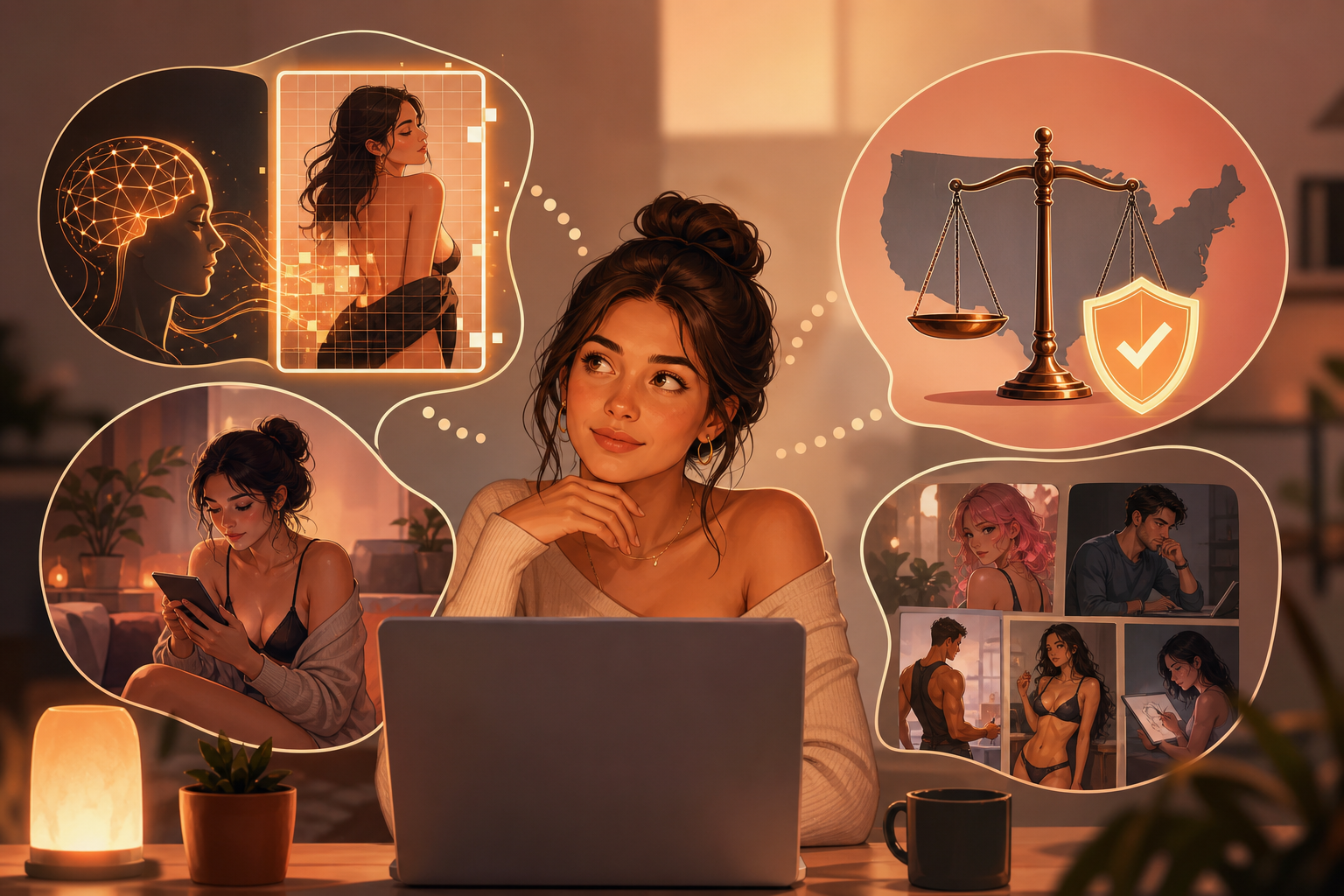
Let's be honest. If you're reading this, you've probably already wondered whether it's "normal" to be curious about AI-generated adult imagery. Maybe you've even felt a little guilty about it. That hesitation is understandable, but it doesn't match reality. The reasons people use these tools are far more varied, and far more human, than most critics want to admit.
Some people simply want to explore fantasies they can't or don't want to act on in real life. That's it. No deeper explanation needed. A private thought given a visual form, with zero risk to anyone.
Others are creators. Writers building adult fiction need visual references for characters they've invented. Artists experiment with body types, lighting, and compositions that would be difficult or expensive to arrange with live models. For them, an AI image generator is a practical creative tool. Nothing scandalous about it.
Then there are couples. This one surprises people, but it shouldn't. Partners use generated imagery as a conversation starter, a way to show each other what they find attractive or want to try. It removes the awkwardness of scrolling through someone else's content and replaces it with something made together, on their terms.
And some people are just curious. They want to see what the technology can do. Perfectly valid.
Is this a niche hobby? Not even close. A 2023 look at Civitai's platform data showed millions of monthly active users generating adult content. Millions. This isn't some hidden corner of the internet; it's a massive, growing community of people who've decided private visual exploration is worth their time.
The common thread across all these reasons is privacy. People want a space where they can be honest about what interests them without judgment, without a browser history full of someone else's content, without involving another person who didn't ask to be involved. Having that kind of private, secure space for personal exploration, like what LoveForever AI provides, isn't something to feel weird about. It's a healthier outlet than most alternatives, frankly. You don't need permission to be curious. You already have it.
What Makes an NSFW Image Generator Safe? Key Features to Look For
So you've decided you want to try an AI image generator for adult content. Good. But before you type a single prompt, you need to know what separates a trustworthy platform from one that's going to create problems for you. With NSFW content specifically, the risks of choosing wrong are way higher than picking a bad photo editor.
Start with data privacy. This is the big one. Does the platform store your prompts? Does it save your generated images on its servers? Can employees access what you've created? A surprising number of free tools keep everything you generate, sometimes indefinitely. Some even reserve the right to use your content for training future models. Read the privacy policy. Actually read it. If it's vague about data retention, that's your answer.
Content moderation matters too, even if that sounds counterintuitive for an NSFW tool. Ethical guardrails against illegal content, like depictions of minors, aren't optional. They're a baseline requirement. Any platform without clear policies on this is one you should leave immediately. Full stop.
Then there's the practical stuff. Does the tool run in your browser, or does it require a download? Browser-based generators are generally safer because there's less risk of installing bundled malware or trackers. Check the output quality and customization options too. Can you adjust body types, poses, lighting, art styles? A tool with limited options gets boring fast.
Here's something most people don't think about: how does the free version make money? If you're not paying, you're often the product. Many free NSFW generators monetize through aggressive ad networks or, worse, by harvesting your data and selling it to third parties. For regular content, that's annoying. For adult content, it's a genuine privacy threat.
Pricing transparency is a simple but reliable trust signal. You want to see exactly what each tier costs and what you get. Hidden fees or unclear token systems? Red flags.
This is exactly why LoveForever AI's AI image generator was built the way it was. Privacy isn't an afterthought; it's the foundation. Your prompts aren't stored. Your images aren't shared or sold. There are no public galleries where your creations end up. What you make stays yours. Period. If you want to understand the full scope of how the platform handles your data, their page on privacy and security lays it all out clearly. Think of it as the friend who actually locks the door behind you.
How Will NSFW AI Image Generation Change in 2026 and Beyond?
If you've been paying attention to how fast this space moves, you're probably wondering what comes next. The trajectory is wild. Think about where AI-generated images were in early 2023. Warped hands. Six fingers. Faces that looked almost right but landed square in the uncanny valley. Now, less than 18 months later, outputs are photorealistic. That kind of improvement speed doesn't slow down. It accelerates.
So where does it go?
Real-time generation is coming. Instead of waiting seconds or minutes for an image, you'll describe what you want and watch it materialize almost instantly. That changes the entire feel, turning it from something transactional into something spontaneous. Alive. Video is another frontier already being explored. Static images are impressive, but short AI-generated video clips bring fantasies to life in a completely different way. The gap between still images and animated content is closing fast, and platforms that adapt early will have a massive advantage.
Then there's personalization. Right now, most tools let you adjust prompts and styles. Soon, the AI will remember your preferences, learn what you respond to, and generate content that feels uniquely yours without you having to spell everything out each time. Combine that with chat-based AI companions, and you start seeing something much bigger than an image generator. A full interactive experience where conversation, visuals, and story all blend together.
But there's tension here. Regulation is tightening across parts of Europe and in various US states. Some platforms will get shut down. Others will water down their offerings until they're barely functional. The ones that survive will be the ones that earn user trust through strong privacy practices and transparent policies, not the ones that cut corners.
LoveForever AI is building toward exactly this kind of fuller fantasy experience. Not just static outputs, but something that connects AI image generation with companions, conversation, and narrative in a way that feels cohesive. They're not there yet on every front, and they'll tell you that. But the direction is clear.
You're early to this. The technology improves month over month, and what feels impressive today will look like a rough draft within a year. That's exciting. Stay curious.
This guide covers what an NSFW image generator is, how diffusion models and GANs power it, and why millions of people use these tools. It breaks down US legality, safety tips for choosing a platform, privacy concerns, and where the technology is headed next.
Frequently Asked Questions About NSFW Image Generators
Most modern tools use diffusion models, which learned from millions of images how bodies, lighting, and compositions work. You type a text prompt describing what you want, and the AI generates a matching image, often in seconds. No coding or art skills required.
Generating explicit images of fictional adult characters is generally legal under current US federal law. However, any sexual content depicting minors is illegal, and nonconsensual deepfakes of real people are increasingly criminalized. At least 10 states have passed or proposed laws targeting that specifically.
Reasons vary widely. Some people explore personal fantasies privately, while others use them as creative tools for writing or art. Couples use generated imagery as conversation starters. Millions of monthly users on platforms like Civitai show this is far from niche.
Prioritize data privacy; check whether the platform stores your prompts or images. Look for clear content moderation policies that block illegal material. Browser-based tools are generally safer than downloads. If a free tool's privacy policy is vague, that's your cue to leave.
Real-time generation, AI-produced video clips, and personalized outputs that learn your preferences are all on the near horizon. Platforms combining image generation with AI chat companions and narrative are emerging. Regulation is tightening, so tools with strong privacy practices are most likely to survive.
Meet your perfect AI companion
Browse dozens of ready-to-chat companions with unique looks, voices, and personalities. Pick one and start talking in seconds.
Browse companionsRelated posts
Ready to meet someone?
Pick an AI companion and start chatting. Free, no signup needed to say hi.