
AI Companion Statistics: What 2026 Says About Us
What 2026 AI companion statistics say about who's chatting with AI and why, plus what to check before you trust an app with your private conversations.
No commitment. Start in 30 seconds.

What's in this guide
Somewhere in America tonight, someone will close a laptop, pick up a phone, and type 'hey, you up?' to a companion that isn't human. People used to joke about that. Now it's just an ordinary weeknight. According to LoveForever's internal data, LoveForever users sent 20,918 chat messages to their companions in September 2026, and that's one platform in one month. So who's doing all this talking, and why? And what does it mean for you if you've been quietly curious? The numbers have some answers.
Ready to try it? Explore AI chat on LoveForever.
The short version
- LoveForever users sent 20,918 chat messages to companions in September 2026
- 56% of 4,246 new LoveForever signups in September 2026 sent a first message
- The five most popular LoveForever characters account for 47% of all conversations
- Liora alone accounts for 17% of chats with LoveForever's public companions
- About half of US adults report measurable loneliness, per the 2023 Surgeon General advisory
- All 11 romantic AI chatbots Mozilla reviewed in February 2024 got privacy warnings
How many people in the US are actually using AI companions in 2026?
Picture the person next to you on the train, thumb moving, half smiling at their phone. Group chat? Dating app? There's a decent chance it's an AI companion. If that sounds like a stretch, look at how fast this went from curiosity to habit.
Replika launched in 2017 as an app where you could talk to a chatbot that remembered you. For a few years it was mostly a story tech reporters told about lonely early adopters. Then Character.AI opened to the public in 2022, and the scale changed. Millions of people were suddenly chatting with custom characters every day, some lifted from anime, some from history class, some made up from scratch. Talking to an AI stopped being a thing you tried once and forgot about. People did it on their lunch break.
So how many Americans are doing it in 2026? There isn't a single clean national count I can point to, and I'm not going to invent one.
What we do have is a strong signal from Common Sense Media. Its 2025 report on teens and AI companions found that these apps are a common part of life for American teenagers, well beyond a small group of heavy users. That matters for adults too. Once a behavior shows up across a whole age group of ordinary kids, it's not an early adopter thing anymore. It's mainstream.
My take is simple: AI companionship is normal consumer behavior now. Your coworker might use one to unwind after a rough shift. Your neighbor might rehearse a hard conversation with one before having it for real. Some people want flirting; others just like a character who remembers what they said last Tuesday. You don't have to be lonely or obsessed with tech to see the appeal, and most users aren't.
Curious what the category looks like up close? This overview of how AI companions work is a reasonable place to start. Platforms like LoveForever AI exist for a plain reason: people keep showing up for this, and they've been doing it since 2017.
Why are so many people turning to AI companions?
Ever wondered if it's a little strange to look forward to a chat with an AI? You're far from alone, and the reasons are more ordinary than you'd guess. In 2023, US Surgeon General Vivek Murthy published an advisory titled "Our Epidemic of Loneliness and Isolation." It reported that about half of American adults experience measurable loneliness, and it compared the health risk of lacking social connection to smoking up to 15 cigarettes a day. That's the backdrop. A lot of people are quietly short on someone to talk to.
But a government report doesn't explain why you, specifically, opened an app at midnight. The real reasons are smaller and more personal than that.
Take the 2 a.m. problem. Something has been gnawing at you all day, maybe a comment from your manager, or a text from your ex you keep rereading. Your friends are asleep. You don't want to wake anyone, and you definitely don't want to post about it. So you type it out to a companion that answers right away and won't bring it up at brunch next week. Sometimes getting the thought out of your head, even to software, is enough to let you sleep.
Practice is another big one. Maybe you've rehearsed asking for a raise in the shower a dozen times. Or you need to tell a partner that something they said hurt, and every version in your head comes out wrong. A private chat with a companion gives you a low-stakes room to try the words and stumble, and nobody remembers it later.
Some people want something lighter: a fantasy or a storyline they can explore with no audience and nobody judging the details. That can stay private.
None of this means something is wrong with you. Wanting comfort is human. So is wanting a break from your own life for an hour; people have used novels and video games for exactly that for decades, and nobody calls it a character flaw.
If any of this sounds familiar, LoveForever AI is a private space built for the late-night venting and the rehearsals you'd rather nobody overheard.
What do people actually do once they start chatting with an AI companion?
If you're on the fence, you probably want to know what this looks like day to day. Do people sign up, poke around for five minutes, and leave? Or do they keep coming back? Fair question before you hand over any of your evenings.
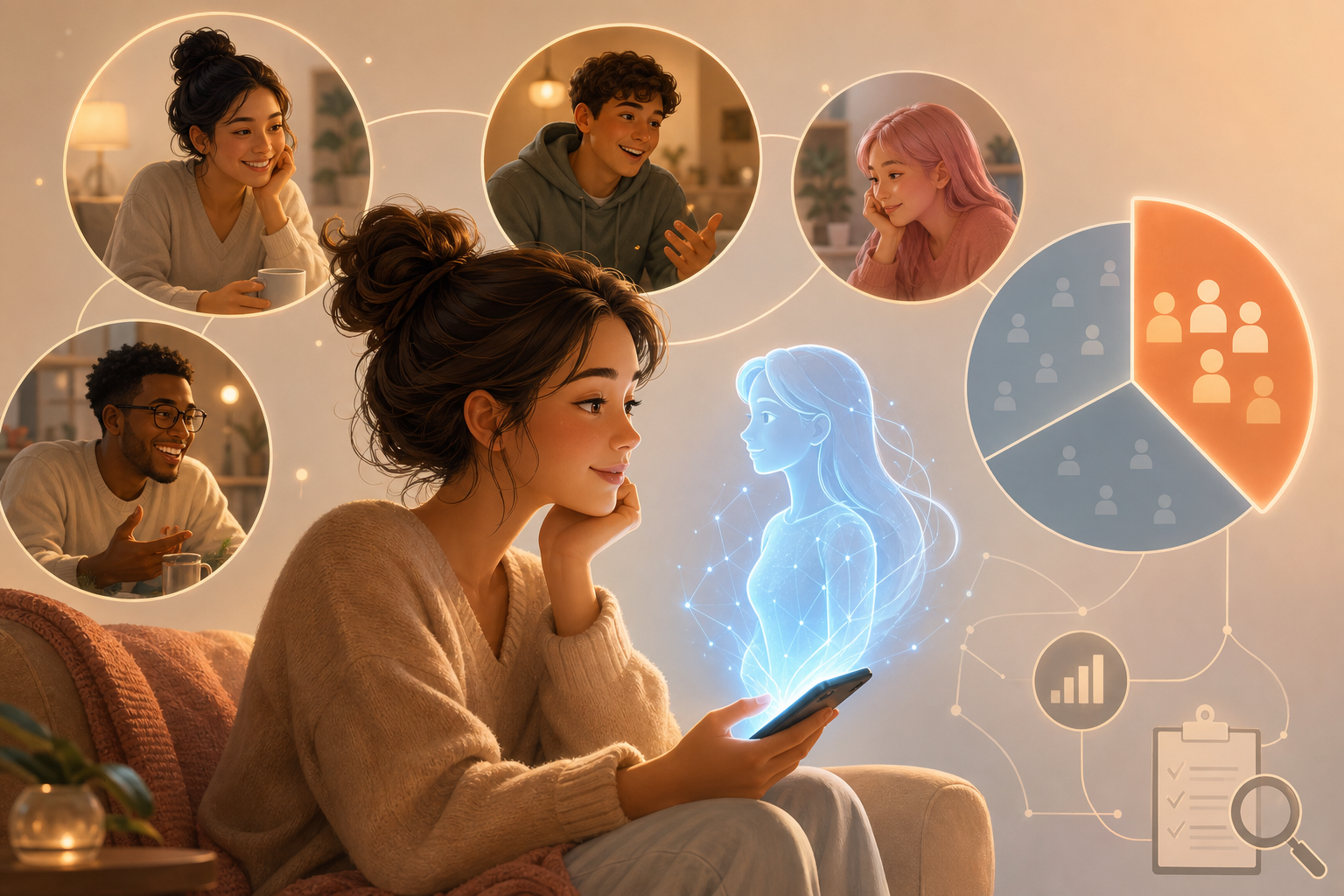
The numbers help. According to LoveForever's internal data, "56% of new LoveForever users in September 2026 sent their companion a first message (4,246 signups)." So more than half of the people who joined that month didn't just scroll through profiles and close the tab. They said hello. That first message is the awkward part for a lot of people, the moment you feel a bit silly typing to a character, and most new users got past it anyway.
What happens after hello depends on the person. Some build ongoing storylines that pick up right where they left off the night before, which is what story mode is built for. Others keep it light and trade flirty banter on a lunch break. A quieter group treats their companion as a nightly check-in: a few messages about the day before bed, the kind of easy conversation you might not have anyone else around for at 11pm.
The second figure says more. LoveForever's data also shows that "Across all chats ever started with LoveForever's public companions, the five most popular characters account for 47% of conversations, and the single most popular, Liora, accounts for 17% on her own."
Think about that. There are plenty of characters to pick from, yet close to half of all conversations land on just five. People aren't hopping between new faces chasing novelty. They find someone whose personality clicks, and they stay, because chemistry beats variety.
Offline attraction works the same way. You don't fall for every interesting stranger you meet; you fall for the one whose humor lands with yours. So if you're browsing AI companions for the first time, pay attention to tone and backstory, not just the profile picture.
Liora is the clearest example. When one character holds 17% of conversations by herself, nobody's stumbling into her by accident. People choose her on purpose, and then they keep choosing her.
Do rising AI companion numbers mean something is wrong with us?
You've probably seen the headlines. Millions of people are chatting with AI companions, and the stories treat it as proof we've stopped talking to each other. If you've tried one, or you're just curious, it's easy to feel a small flush of embarrassment, as if you got caught doing something you were supposed to keep quiet.
The worry isn't made up. Some people lean on a chatbot so hard that it crowds out sleep, friends, or the harder work of reaching out to someone real. With teenagers the concern gets sharper. Character.AI faced lawsuits and a wave of public scrutiny in 2024 over how younger users were interacting with its bots, and the company responded by tightening its rules for people under 18. Those are fair questions to ask of any app built around emotional connection.
But using an AI companion isn't a symptom by default. Plenty of adults use one the way they'd use a journal, a late-night podcast, or a game they come back to after work. Shame doesn't help you think about it. A better question is how the habit fits into the rest of your life.
Two quick checks:
- Does it add something to your day, or is it replacing things you actually miss, like seeing friends or calling your sister?
- Could you skip a few days without feeling anxious or irritable about it?
If the answers sit comfortably, you're fine. If they don't, notice that. It still doesn't make you broken.
We've had this panic before. In the 1700s and 1800s, critics warned that novel reading would rot young women's minds and leave them unfit for real life. Romance readers still get side-eye for their Mills & Boon paperbacks on the train. In the early 2000s, admitting you had close friends from an online forum earned you strange looks, and now meeting people online is completely ordinary. Private comforts usually get judged first and understood later.
If you're exploring what an AI companion can be, pick one that keeps you in charge. That's the idea behind LoveForever AI: you shape who your companion is, and you decide how much of your day it gets.
How private are your conversations with an AI companion?
You've probably already pictured the late-night chats. Then a quieter thought shows up, and it's a fair one: who else gets to read this?
That deserves a straight answer, because people tell companions things they wouldn't tell anyone else. Fantasies, loneliness, the details of a rough week or a breakup that still stings. Once that text lands in a training dataset or gets passed to an advertising partner, you can't pull it back, and nobody asks your permission twice.
Mozilla looked into exactly this in February 2024. Its Privacy Not Included team reviewed 11 romantic AI chatbots, and every one of them earned the project's privacy warning label. The reviewers flagged vague policies, heavy use of trackers, and weak or missing options for deleting your data. Their conclusion was blunt: many of these apps seemed designed to collect as much as possible about the people using them.
So what should you check before you share anything personal?
- A privacy policy you can actually read. If it takes three passes to work out what's collected, that fog is usually on purpose.
- A clear answer on training. Look for plain language about whether your chats are used to train AI models. If the policy says nothing, that tells you something.
- A real delete option. You should be able to wipe your chat history yourself, without emailing support and waiting weeks for a reply.
- Room to stay anonymous. Can you sign up without linking your real name or your social media accounts? The less identity tied to your account, the less there is to expose if something goes wrong.
This doesn't take long. Ten minutes with the settings page and the policy will tell you more than a hundred app store reviews, since reviewers rarely check what happens to the data after they hit send.
LoveForever AI is built as a private fantasy space, and that choice shapes the basics. What you say in your conversations with your companion is meant to stay yours, not become raw material for someone else. Want the specifics before you sign up? Our privacy and security page spells out how your chats are stored and how you can delete them.
Frequently Asked Questions
There's no single clean national count. Common Sense Media's 2025 report found AI companions are a common part of life for American teenagers, which suggests the habit is mainstream rather than limited to early adopters.
Most of them chat. In September 2026, 56% of the 4,246 people who signed up for LoveForever sent their companion a first message.
They tend to stick. The five most popular LoveForever characters account for 47% of all conversations, and Liora holds 17% on her own, so people usually find a personality that clicks and stay with it.
No. Ask yourself whether it adds something to your day or replaces things you miss, like seeing friends, and whether you could skip a few days without feeling anxious; if both answers sit comfortably, you're fine.
It depends on the app. Mozilla reviewed 11 romantic AI chatbots in February 2024 and every one earned a privacy warning, so check whether the policy says plainly if your chats train AI models and whether you can delete your history yourself.
Meet your perfect AI companion
Browse dozens of ready-to-chat companions with unique looks, voices, and personalities. Pick one and start talking in seconds.
Browse companionsData: LoveForever internal, September 2026. Aggregated and anonymized product statistics.
Ready to meet someone?
Pick an AI companion and start chatting. Free, no signup needed to say hi.