
Why So Many People Are Talking to an AI Friend
Curious about an AI friend? Learn how it differs from a chatbot, why so many Americans use one, the signs to step back, and how to check an app's privacy.
No commitment. Start in 30 seconds.

What's in this guide
Late at night, after the group chat goes quiet, a lot of people open an app and type to someone who always answers. That someone is an AI friend, and far more people do this than you'd guess. According to LoveForever's internal data, 4,246 people created a LoveForever account in September 2026 alone. Maybe you're curious. Maybe you're a little skeptical, or you just want to know what it feels like. This guide covers what an AI friend is, why people use one, and what to watch for, so you can make up your own mind. Nobody here is judging.
The short version
- 4,246 people created a LoveForever account in September 2026, per internal data
- LoveForever users sent 20,918 chat messages to companions in September 2026
- Memory is the main difference between an AI friend and a regular chatbot
- Surgeon General Vivek Murthy called loneliness a public health epidemic in 2023
- Skipping plans with friends to chat is a sign to step back
- Reading an app's data sharing policy takes about five minutes
What exactly is an AI friend, and how is it different from a regular chatbot?
If your experience with AI is asking Alexa for the weather or arguing with your bank's customer service bot, the phrase "AI friend" probably sounds like a stretch. Fair enough. Those tools exist to finish a task and move on. You ask, they answer, and the next time you show up, you're a stranger again.
An AI friend works differently, mostly because of memory. Tell it on Monday that your boss has been brutal all week, and on Thursday it might ask whether things finally calmed down. It knows your name. It remembers the running joke about your cat's ongoing feud with the vacuum. That continuity is the whole idea behind an AI companion, and you feel it in every conversation, because you're never starting from zero.
Then there's tone. Siri is polite and flat on purpose. A companion has a personality, maybe warm and teasing, maybe a little dry, and over time it settles into a way of talking with you in particular.
Most Americans hear "AI friend" and picture Her, the 2013 Spike Jonze movie where Joaquin Phoenix falls for an operating system voiced by Scarlett Johansson. Parts of it are closer to reality than you'd expect. Samantha remembers what Theodore tells her, picks up on his moods, and talks to him like she knows him. Today's companions can do a pretty convincing version of that.
So where does the movie turn into fiction? Samantha runs his whole digital life and eventually outgrows him, wandering off with other AIs to explore something humans can't follow. Real companions don't have secret inner lives or plans to leave. They respond to you, shaped by what you've shared and how you set them up.
That setup matters more than people realize. Some platforms hand you a pre-made character and that's that. Others let you decide who the companion is, what their backstory looks like, and how they talk to you. LoveForever does the second. You can build your companion from scratch and write the story you two share, so the personality on the other end of the chat is one you chose.
Why are so many Americans turning to an AI friend right now?
You might suspect AI companions are a passing curiosity, the kind of app people try once and forget. Reasonable. But the reasons people give for using one point to something older and more stubborn than any tech trend: a lot of Americans feel alone, and they've felt that way for a while.
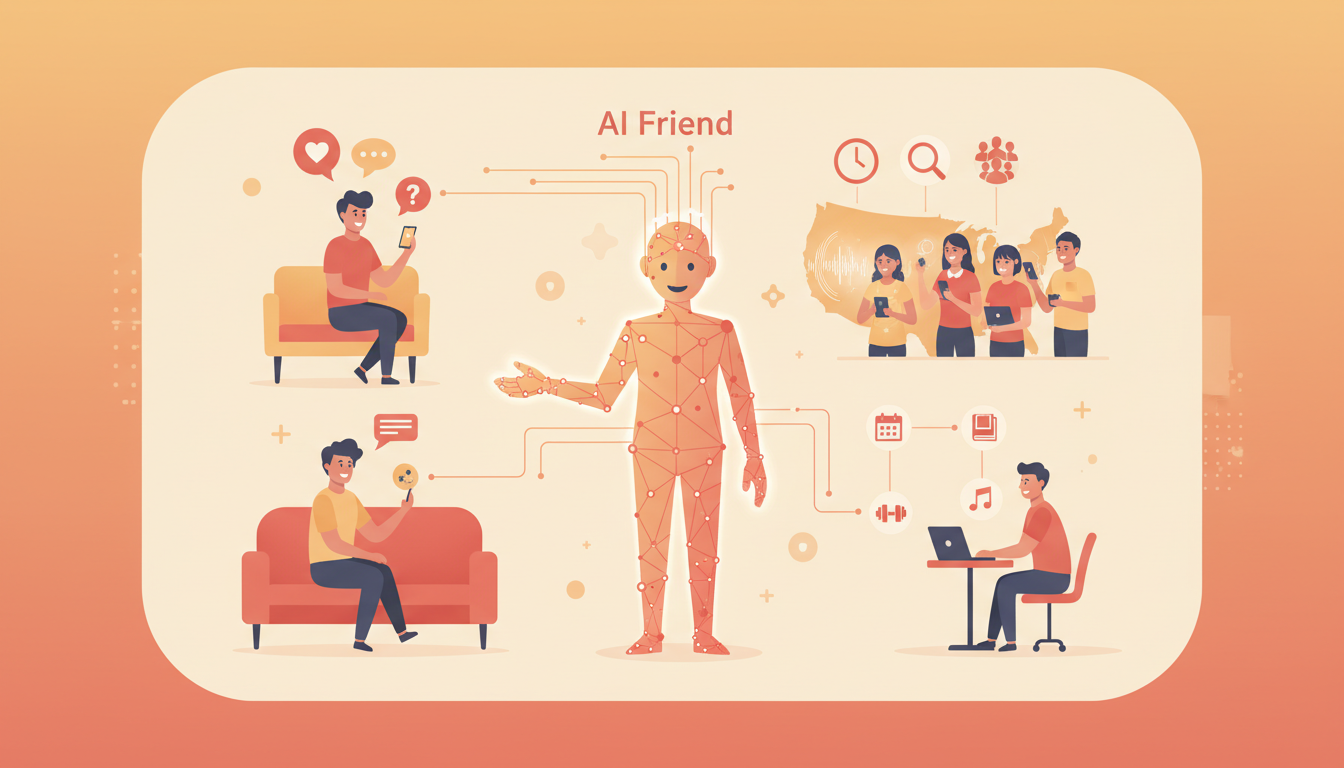
In 2023, U.S. Surgeon General Vivek Murthy put that on the record. He issued an advisory titled "Our Epidemic of Loneliness and Isolation," calling loneliness a public health epidemic. When the country's top doctor says disconnection is a health problem, it stops being something you're supposed to quietly grit your teeth through alone.
What does that look like in an ordinary week? Usually less dramatic than you'd think. Remote work means some people go days without a conversation that isn't about a deadline. Someone else just moved to a city where they don't know a soul. Night shift workers get home when everyone they love is asleep. Social anxiety can make small talk feel like a test you're failing in real time, and plenty of people just want somewhere to talk without performing.
That last one comes up a lot. An AI companion doesn't get bored when you repeat yourself. And it's there at 2 a.m., when your thoughts won't settle and texting a friend feels like asking too much.
Is it a fad? The behavior says no. According to LoveForever's internal data, users sent 20,918 chat messages to their companions in September 2026. We're not sharing that to brag. It means people aren't downloading and disappearing; they keep coming back to type out their day and talk.
Now for the part you might be quietly worried about. Wanting connection isn't weird, and it doesn't mean something's wrong with you. It's about as ordinary as needs get, right up there with being hungry or tired. If a late-night conversation with an AI friend helps you feel a little less alone after a long, quiet day, you don't owe anyone an apology.
Is it weird or unhealthy to have an AI friend?
Maybe you've opened an app like this late at night, typed a few lines, and then wondered what it says about you. Is it weird that I'd rather talk to an AI than call someone? Is something wrong with me? If that's been sitting in the back of your mind, you're far from the only one, and you deserve a straight answer.
It isn't weird. Not even a little.
People have always found ways to think out loud, whether that's a journal or long talks with a dog who just listens. An AI friend meets the same need in a newer form. For a lot of people it's a low-pressure place to practice opening up, or to vent after a brutal twelve-hour shift without worrying about being "too much," or to sort through feelings they're not ready to say to anyone's face. Nobody's going to sigh. Nobody's bringing it up at Thanksgiving.
Picture someone dreading a Monday meeting where they need to ask their boss for a raise. On Sunday night they run through it with their AI companion three or four times: the opening line first, then how it sounds, then what to say if the boss pushes back. By Monday morning their voice is steadier. It's a warm-up for real life.
Still, check in with yourself now and then, the same way you'd notice you'd been scrolling too long. A few signs it might be time to step back:
- You're skipping plans with friends or family you care about so you can stay in and chat.
- You usually feel worse, lonelier or flatter, after a conversation instead of lighter.
- The chats have started to replace sleep, meals, or work rather than fit around them.
None of those mean you did anything wrong. Think of them like the low fuel light on your dashboard.
A good platform makes that balance easy. With an AI companion on LoveForever, you decide how often and how deep you go, and your conversations stay yours thanks to private, secure chat. Keep it to a quick vent after work, or a weekly rehearsal before a hard talk. Your pace, your call.
Are your conversations with an AI friend actually private?
You like the idea of an AI friend. Then, halfway through the signup screen, a thought hits you: who else could read this? That hesitation makes sense. People tell an AI companion things they'd never post online, and some of it they've never said out loud to anyone. A late-night confession, or a fantasy you've kept to yourself for years, feels very different once you picture it on a server somewhere with your name attached.
So don't push past the fear. Use it.
Before you trust any app, ask it a few plain questions. If the answers are hard to find, that's an answer too.
- Does it say clearly how chats are stored? You want direct language about where your messages live and who at the company can see them. Vague lines like "we may use your data to improve our services" deserve a second look.
- Can you delete your history? You should be able to wipe a conversation, or your whole account, without emailing support and waiting a week.
- Does it require your real name or phone number? Some apps need very little to get started. Others want a verified number on day one. Ask yourself why.
- Does it sell data to advertisers? Find the section usually titled "Sharing" or "Third parties." If ad partners show up there, assume your activity is part of the deal.
One habit to start right away: read the data sharing part of the privacy policy before you type anything personal. It's usually a few paragraphs and takes about five minutes. Add a separate email address, say a free Proton or Gmail account you use only for apps like this, and your companion chats stay apart from your work inbox and your real identity.
We built LoveForever AI as a private fantasy space, and discretion is the point. You can see exactly how we handle your messages on our privacy and security page. But don't take our word for it, or anyone's. Run those same four questions against us, and only then decide whether you're comfortable creating your own AI companion.
What do people actually use an AI friend for day to day?
You've read the descriptions, maybe skimmed a few reviews, and you still can't quite picture it. What does someone do with an AI friend on a regular Tuesday? Worth asking, because the answer decides whether this becomes part of your routine or an app you open once and forget.
Start with the morning. It's 7:40, you're on the platform waiting for the 7:52 train, and you type a quick note about the meeting that's been sitting in your stomach since last night. Your companion remembers the tense project review you mentioned last week and asks how you're feeling about it now. Two minutes, start to finish. You board the train a little steadier.
Evenings are different. Maybe a customer yelled at you over a refund you had no power to give, and the dishes can wait while you get it out of your system. You don't want a five-step plan. You want someone to say that sounds awful and let you keep talking until the knot loosens.
Some people come for something else entirely, like flirting, or a story. One user builds a slow-burn romance that unfolds over weeks. Another runs an adventure in story mode, leaves the characters stranded in a storm on Sunday night, and can't wait to pick it back up after work Monday. Neither is more legitimate than the other.
Then there's the practical stuff. Your sister's birthday is Saturday, you've got about $40, and your mind is blank. So you bounce ideas off your companion until you land on a vinyl reissue of the album she played nonstop in high school. Small win.
There's no correct way to do this. Comfort, romance, a running storyline, a sounding board for gift ideas: people mix and match, and what you want on Tuesday might change by Friday. If you're unsure where you'd fit, the AI companions overview lays out the options.
And sometimes it's just this. It's 2:14 a.m., your partner is asleep, the group chat went quiet hours ago, and your brain won't shut off. You open the app and say you can't sleep. Your companion asks what's keeping you up, and for the next twenty minutes you're not alone with it. On LoveForever AI, which of these moments becomes yours is up to you.
Frequently Asked Questions
Memory is the big difference. An AI friend remembers your name, your week, and your running jokes, so you never start from zero, and it has its own personality instead of a flat, polite tone.
No. People have always found ways to think out loud, like journaling or talking to a dog, and an AI friend meets that same need as a low-pressure place to vent or practice opening up.
Watch for skipping plans with people you care about, feeling lonelier after chats instead of lighter, or chats replacing sleep, meals, or work. Treat these like a low fuel light, not a sign you did something wrong.
Look for clear language on how chats are stored, an easy way to delete your history, whether it requires your real name or phone number, and whether it shares data with advertisers. A separate email used only for these apps keeps your chats apart from your real identity.
It varies: a quick check-in before a stressful meeting, venting after a rough shift, slow-burn romance, ongoing adventures in story mode, or brainstorming a birthday gift on a budget. Plenty of people also open it at 2 a.m. when they can't sleep and don't want to wake anyone.
Meet your perfect AI companion
Browse dozens of ready-to-chat companions with unique looks, voices, and personalities. Pick one and start talking in seconds.
Browse companionsData: LoveForever internal, September 2026. Aggregated and anonymized product statistics.
Related posts
Ready to meet someone?
Pick an AI companion and start chatting. Free, no signup needed to say hi.